It feels like every time we know how to recognize one trick, scammers create a new one. The terrain of deceit is evolving more rapidly than ever before, driven by new technology and an insatiable desire for our personal data and deposits. The object of any financial scam is to circumvent our rational mind through urgency, fear, or enthusiasm.
Being aware of these techniques is not being fearful but becoming confident. Once you know what to see, you'll be able to spot the red flags from a mile away. Let us learn about the most prevalent financial scams of 2025. Find out what these scams are, how they operate, and most importantly, what you can do to protect yourself.
What is a Financial Scam? Understanding the Modern Threat
A financial scam is a fraudulent plan that aims to trick you out of your cash or private data. Although the essence is ancient, the techniques have significantly changed. Scammers today are not only solo artists; they tend to be members of highly advanced criminal organizations that utilize cutting-edge tools such as Artificial Intelligence (AI) to sound more authentic than ever before.
The scope is immense. As per recently made public statistics from the Federal Trade Commission (FTC) on March 10, 2025, consumers lost more than $12.5 billion to fraud in 2024, a 25% year-over-year increase. This increase wasn't due to additional reports, but rather because a greater percentage of victims actually lost money, increasing from 27% in 2023 to 38% in 2024, and recorded more than $5.8 billion in reported losses by consumers. Internationally, the number is astronomical, with the Global Anti-Scam Alliance (GASA) reporting that more than $1.03 trillion was lost in 2024. Your first and strongest defense is to understand the particular scams making the rounds in 2025.
The Most Prevalent Financial Scams of 2025
Scammers never stop evolving their tactics, leveraging the newest technology and our human weaknesses against us. Below are some of the most common scams you should know about.
1. The Sneaky AI-Powered Fraud
Artificial intelligence (AI) is now a scammer's best friend. Gone are the days of a poorly-written email; AI can create realistic voice, image, and text. Scams suddenly sound so real. For instance, a scammer may use AI to sound like your child or grandchild calling with a fabricated emergency, begging for money immediately. These "deepfake" frauds appeal to your emotions and the immediacy of the circumstances to cause you to act reflexively.
A victim who receives such a call from a relative may not pause to ask himself whether it is genuine until it's too late. In another version, scammers use AI to create incredibly realistic websites and advertisements for fake products or investments. They can even generate AI-driven chatbots that can hold convincing conversations with you, building a sense of trust before asking for your money. This is the new, more sophisticated version of the romance scam.
2. The Impersonation and Imposter Scam
This is a scam all about pretending to be who you are not. They may claim to be an employee from your bank, a government representative from the IRS, or even a police officer. They will employ fear tactics by telling you that you owe money or are in trouble with the law and need to pay immediately. In a 2023 FTC report, government impersonation scams alone resulted in enormous losses, with a median loss of $76 million.
Scammers also make you believe they are from popular companies. They could send you a text message that appears to be from a delivery company, informing you that your package has a problem and that you should click a link to fix it. That link will direct you to a phony website created to rob you of your personal data. One of the most popular lines used by scammers is, "Your account has been hacked, click here to protect it," when actually, they are attempting to hack it themselves.
3. The "Too-Good-to-Be-True" Investment Scam
We all dream of making money overnight, and scammers are well aware of it. They will post false investment proposals on social media or via SMS. These schemes guarantee incredible returns with minimal to no risk. They may be discussing the next big cryptocurrency or a "secret" stock that is going to blow up. They may also set up fake websites or apps with impressive-looking graphs to give the illusion that your investment is growing. They may even allow you to withdraw some small amount of "profit" initially to gain your trust, so you can invest more.
After you invest a lot of money, they vanish, and you realize the whole thing was false. In 2023, Americans aged 60 and older reported losing over $3.4 billion to financial scams, according to the FBI’s Internet Crime Complaint Center (IC3). This marks an 11% increase from the previous year, with the average loss per victim reaching $33,915. Tech support scams were the most frequently reported, while investment scams caused the highest financial losses, exceeding $1.2 billion.
4. The Slick Phishing and Smishing Scam
This is an old one, but it's still pretty effective since it keeps changing all the time. Phishing is a scheme that involves using emails to make you hand over personal details. Smishing does exactly the same, only with SMS. You may receive a text message that reads, "Your bank account is locked. Click this link to unlock it now." The link leads you to an imitation website that is a perfect replica of your bank's site, where they will ask you to provide your login credentials.
After you provide them, the scammer gains access to your actual account. The purpose of the scammer is to get you to panic and react in haste. They may also employ emotional terms, such as a message received stating you won an award, but have to give them your information to receive it.
5. The Fake Job and Employment Scam
Increased remote work has generated a new way for scammers to operate. They create fake job postings on job websites or social networks that offer you high wages and flexible schedules. The ploy occurs when they request money up front, usually for "training," "equipment," or "background checks." You may also be requested to "deposit" a check that you receive from them and then wire some of it back to them.
The check is always a fake one, and your bank will hold you liable for the money you wired. A risky form of this scam is when they request sensitive personal data, such as your Social Security number or bank account information, for "onboarding." They use that information for identity theft. The FTC received a large surge in these kinds of scams in 2024, demonstrating how quickly they are expanding.
6. The Scandalous QR Code Scam
QR codes are ubiquitous, from menus in restaurants to billboards. Scammers are exploiting the convenience. They could place a false QR code sticker over an actual one on a public surface, such as a parking meter. When you scan the imposter code, it may direct you to a malicious site that extracts your data or installs malware on your phone.
Another type is when they send you a package that you never placed an order for, with a QR code on it, and tell you it's a present. The code redirects you to a bogus survey that requires you to give them your personal data.
7. The One-Time Passcode (OTP) Scam
Your one-time passcode is an important aspect of keeping your accounts secure, but there's a way that scammers are using it against you. The scammer gets your personal information through some other avenue first. Next, they attempt to log into your account, which causes an OTP to be sent to your phone.
Along with this, they call you, feigning to be representatives of your bank's security or fraud department. They'll tell you, "We've noticed a suspicious login into your account. We have sent you a code to prevent it. Read the code to us." If you provide them with the code, they use it to gain instant entry into your account and steal your money. They apply pressure and a sense of urgency to persuade you to give them the very thing designed to save you.
How to Keep Yourself Safe?
Being safe does not take a lot of technical expertise. It is just about being slightly more careful and obeying some simple rules of common sense.
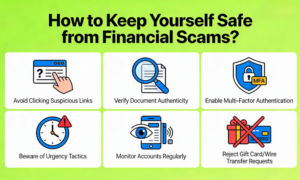
Think Before You Click: Whenever you receive a message or email with a link, particularly one that appears to be urgent, stop and reflect. Rather than clicking on it, type the address of the official site yourself. A bank is never going to send you a link to log in and sort out a problem.
Check Everything: If a caller says they are from your bank or any government agency, hang up. Look for the official phone number on their website or on the back of your debit card and call them directly. This step could prevent you from losing a lot of money.
Employ Strong Security: Employ strong, different passwords for each of your online accounts. Don't reuse the same password for all. And whenever possible, employ two-factor authentication (2FA), which asks for a code from your phone along with your password. This makes it much more difficult for scammers to access your account.
Watch Out for Urgency and Emotional Manipulation: Scammers will attempt to frighten you ("act quickly or you will lose all your money") or manipulate your emotions ("your grandson is in trouble"). When you are under pressure or being rushed, that's a big red flag. Take a deep breath and ask a friend or family member for a second opinion.
Keep an Eye on Your Accounts: Check your bank statements and credit card statements regularly for unauthorized transactions. You can also request alerts from your bank to get notified whenever a transaction is initiated.
Refrain from Sending Money Unconventionally: Never send money to an unknown person via wire transfers, gift cards, or cryptocurrency. These forms of payment are nearly impossible to trace or retrieve.
Actions To Be Taken If You Get Scammed
Your best defense against financial scams is to be aware. Educate your family members, particularly older adults and young adults, on scams. Keep your devices updated, have strong passwords, and never make impulse financial decisions.
In case you think you've been scammed:
- Notify the Federal Trade Commission at reportfraud.ftc.gov
- Contact your bank instantly
- Update your passwords and activate multi-factor authentication
- Report it to the local police
Final Thoughts: Your Awareness is Your Best Protection
Financial fraud is a complicated world, but your protection can be simple. The one thing that runs through all of these scams is the effort to play on your emotions, fear, urgency, or excitement, to override your rational thinking. By remaining educated on the newest tactics, being properly skeptical, and going through the easy verification process above, you can safely venture online.
To learn more, visit SecureITWorld!
FAQs
Q1. What is the most prevalent financial scam of 2025?
Answer: Account takeovers and impersonation scams are the most frequently reported, particularly those involving voice or video tricks.
Q2. What are some typical financial scams?
Answer: Typical financial scams are tricks to steal your money or your personal information. They are usually sent via spoofed emails, calls, or websites that pose as authentic ones.
Q3. What are the top 5 scams?
Answer: The top five most reported scams are fake investment offers, phishing emails, impersonation calls, romance scams, and account takeover fraud.
Q4. How do financial scams operate?
Answer: They cheat individuals by posing as somebody with credibility. They request money, private details, or login credentials and after that exploit them to perform fraud.
Must Read:
What Is a Financial Scam? Types, Tactics, and Why They Happen
Safeguard Your Finances: Top Financial Sector Cybersecurity Methods to Consider