Cybersecurity has become a continuous process instead of just a one-time solution. Robust security seeks continuous monitoring to identify vulnerabilities at an early stage and eliminate them before any unfavorable situation arises. In this regard, adopting AI agents in cybersecurity can be a beneficial strategy.
As data states, the worldwide market for agentic AI in cybersecurity was valued at $22 billion in 2024 and is set to surpass $322 billion by 2033. The reasons for such growth are undoubtedly the increasing demand for autonomous threat detection and real-time vulnerability management.
However, there are certain risks of AI agents in cybersecurity as well. In this blog, we will learn how AI agents can be advantageous for advancing cybersecurity practices, alongside AI-led cyberattacks and use cases for adopting AI agents while building a robust security framework. Let’s dive in...
What are AI Agents in Cybersecurity?
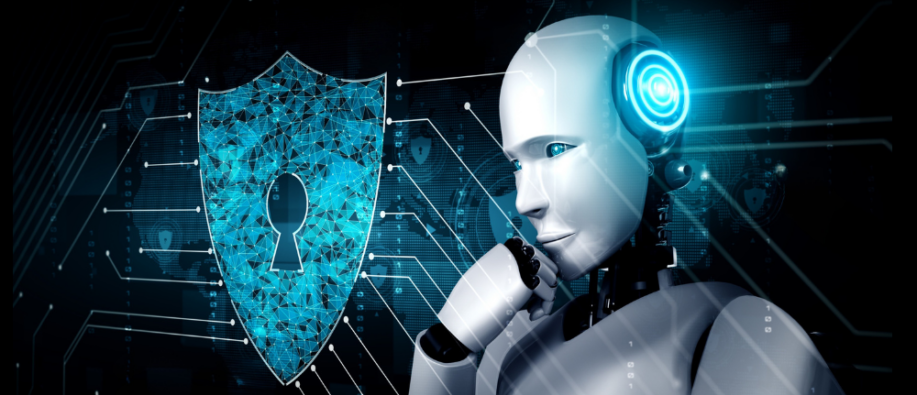
AI agents in cybersecurity refer to the use of autonomous programs that sense the security environment, make decisions, and act to achieve specific goals. These goal-oriented systems continuously learn and adapt to improve security. An AI agent can watch network traffic for anomalies, triage alerts, or even quarantine threats on its own, functioning like an always-on digital security analyst.
AI agents incorporate real-time data to identify, analyze, and eradicate threats, all autonomously. While requiring minimal human intervention, AI agents save time and resources while building a strong security infrastructure. In this regard, AI agents use machine learning capabilities, natural language processing, and neural networks.
How Can AI Agents Become a Threat to Cybersecurity?
An AI agent in cybersecurity also describes how attackers are exploiting AI agents to execute dangerous cyberattacks. It includes the drawbacks of artificial intelligence that can threaten cybersecurity frameworks. Considering the downside, over 73% of CISOs around the globe are critically concerned about the risks of AI agents in cybersecurity.
Furthermore, AI hallucination can be a great hurdle while building an AI-driven security framework. While AI models hallucinate, they can miss high-stakes situations and misinterpret signals. Such drawbacks can lead to inefficient incident response and cybersecurity practices.
Benefits of Integrating AI Agents in Security:
- Uninterrupted Monitoring and Scalability:
AI agents work around the clock and automatically scale across many systems. They extend protection to new assets immediately, keeping pace with growing environments. - Reduced Alert Fatigue:
Agents filter out noise and highlight the most serious alerts by correlating data across users and devices. This prioritization eases the task for human analysts, allowing them to focus on real threats rather than sifting through noisy data.
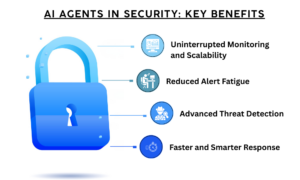
- Advanced Threat Detection:
Agents learn normal behavior baselines and detect precise anomalies, such as unusual login patterns or data transfers; that static rules might miss. This helps in tracing minor breaches and insider threats earlier. - Faster and Smarter Response:
AI agents can detect early-stage weaknesses and take action in seconds. These fast responses directly reduce Mean Time to Detect and Respond (MTTD/MTTR). Transferring routine work to agents also gives human teams more bandwidth for complex tasks.
What AI Can’t Do in Security?
Though AI agents in cybersecurity enable several benefits while building a robust security framework, they can be inefficient in several areas. And that’s when human intervention is required.
Highly Data-Dependent: AI needs vast training data. If the datasets have quality issues, or biased, the AI agents may miss real threats and flag harmless activity. Integrating AI cannot fix a weak security program.
Explainability and Trust: Many AI models are ‘black boxes.’ Teams need to understand agent decisions, so clear, auditable logs are essential. Without transparency, analysts may hesitate to trust automated actions.
Human Oversight Required: Agents can handle routine tasks, but they can’t manage every situation. Security teams typically keep humans in the loop for unusual or high-risk cases. Full autonomy can lead to errors, so experts review critical decisions.
Flaws in AI and False Alarms: AI can be fooled or limited. New or adversarial tactics might evade detection if models aren’t retrained. Agents can also initiate false alarms. So, if they trigger too many non-threats, analysts may eventually ignore their warnings.
Use Cases: What Actually Works While Using AI Agents in Cybersecurity?
- Automated Alert for Early Detection:
Agents examine thousands of security alerts, correlating similar events, and prioritizing only those that need attention. This intelligent approach for early detection saves time for manual assessment. - Automated Investigation and Response:
Agents can extract logs from endpoints, cloud services, and identity systems to map out the incident once an alert is confirmed. These agents identify the attacker’s path and even execute predefined actions instantly. - Dynamic Threat Identification:
AI agents actively look for signs of compromise rather than just waiting for alerts. They analyze baseline behavior, generate hypotheses, and query logs to spot stealthy anomalies. Over time, the agents learn what unusual patterns indicate real threats, catching attacks early. - Vulnerability and Code Security:
AI agents help find bugs and weaknesses in a security framework. For example, they can scan codebases and dependencies to detect zero-day vulnerabilities before public advisories exist. Some agents even suggest fixes or automatically generate patches.
Securing the Future with Responsible Adoption of AI!
AI agents are gradually becoming powerful catalysts in cybersecurity. When used wisely, they compress response times and surface hidden threats, making operations more efficient. However, experts recommend keeping a balance, where organizations should adopt AI responsibly, with humans overseeing critical actions.
The future of cybersecurity depends highly on this human-AI partnership. By combining AI’s speed with human insight, organizations can build more resilient defenses against dangerous threats.
Follow our blog posts for the latest cybersecurity updates and insights!
FAQs:
Q1. What are the 5 types of AI agents?
Answer: The five types of AI agents are simple reflex, model-based, goal-based, utility-based, and learning agents.
Q2. What are the 5 components of AI?
Answer: The five major components of AI are Learning, reasoning, problem-solving, perception, and language understanding.
Q3. Can generative AI be used in cybersecurity?
Answer: Yes, generative AI can be used in cybersecurity.
You Might Like:
How AI Agents for Detection Optimization Strengthen Security?