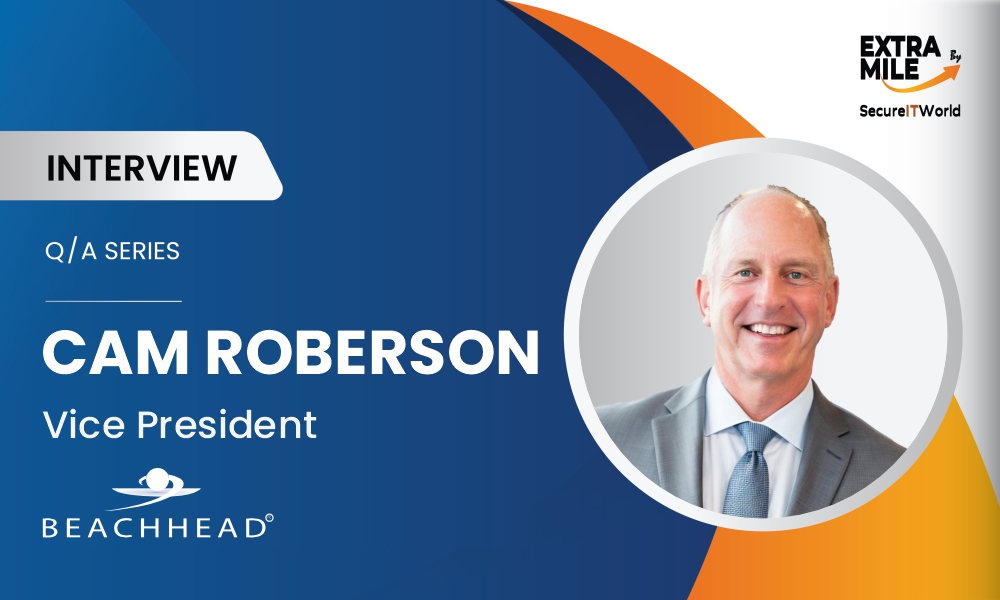
Welcome back to another episode of ExtraMile by SecureITWorld, your go-to interview series for insightful conversations with the leaders, innovators, and strategists, driving the future of the tech and cybersecurity world! As the cyberthreat landscape is growing more complex, staying informed isn’t optional; it’s essential, and we do exactly that.
Join us on today’s discussion as we’re super excited to feature Cam Roberson, Vice President at Beachhead Solutions, the company on a mission to give SMBs and MSPs compliance and security capabilities that large-scale organizations pay a premium for, without the complexity or the cost.
Cam brings fascinating experience from product management at Apple to building and running an advertising agency that grew into one of the largest by revenue in the San Francisco Bay Area. At Beachhead Solutions, he leads sales, marketing, and channel development. Cam has been instrumental in building Beachhead’s MSP reseller channel that drives 80% of the company’s revenue.
In this conversation, he focuses on various facets, including why encryption alone is no longer enough, the Beachhead Secure platform, and how ComplianceEZ 2.0 is transforming compliance lifecycle management. Further, he explains what SMBs and MSPs should prioritize in their data protection strategies today.
Hello Cam, great to have you with us today! Let’s make it a great one!
1. With your background in product positioning, marketing, sales, and running businesses, which core elements do you never miss including in your strategy?
Cam. I need to always keep an honest read of the world our buyers actually operate in. Our BeachheadSecure platforms are built for SMBs and the MSPs who support them, and those audiences rarely have a dedicated security team, a GRC analyst, or budget headroom for bloated enterprise tools. Any product roadmap or sales strategy that ignores those realities fails the moment it reaches the market.
A good example is actually how the ComplianceEZ tool came to exist in the first place. We were talking with one of our MSP partners about why his firm had standardized on BeachheadSecure. The answer came down to something simpler than any feature list. BeachheadSecure had been continuously checking the compliance control requirements his clients were accountable for, and that coverage was the one thing his team could not reproduce on their own. That conversation kicked off the project that became ComplianceEZ, where we built something that connects every BeachheadSecure capability to the underlying compliance control it satisfies and makes that mapping visible at a glance.
The strategy lesson is that the most useful product decisions come from listening to what customers are actually solving for, not from what we think they should care about.
2. What capabilities should firms prioritize in a modern data protection strategy, and how should they choose the right platform?
Cam. The most important shift is recognizing that compliance frameworks have become the objective measure of sound security. They were built by people who studied what works, and they apply whether or not a regulator is looking over your shoulder. Vendors love to sell acronyms and brand names as a proxy for security, but frameworks like HIPAA, CMMC 2.0, PCI DSS, and NIST 800-171 do not care about any of that. They care about whether the capability exists in your environment and whether you can prove it on demand.
That reframing changes how firms should think about their security stack. Encryption is necessary but no longer sufficient on its own, and turning on BitLocker across a fleet of laptops only partially satisfies what these mandates actually require. Managed, layered encryption still matters enormously. It is the only protection that keeps exfiltrated data from being readable, which is exactly the scenario ransomware 2.0 attackers are counting on. What matters is having the full set of controls the framework calls for, including least-privilege access, automated risk response, and continuous compliance visibility, and being able to map every capability in your stack against the specific controls it satisfies. ComplianceEZ does that mapping automatically for the 84 capabilities in BeachheadSecure and lets businesses document their other third-party tools against the same control numbers. That is the work compliance teams used to pay consultants to do, and it is increasingly what cyber insurers and enterprise customers expect to see during procurement.
When it comes to choosing a platform, I tell businesses and MSPs to look past the feature list and ask a few harder questions. Does it cover all the devices you or your clients actually use, including PCs, Macs, phones, tablets, USB storage, and servers, from one console? Does it map cleanly to the specific compliance mandates you are accountable for, with documentation an auditor will accept without a follow-up meeting? Will it respond automatically when something goes wrong, or does every incident wait on an administrator? Can a small IT team or an MSP run it without hiring a dedicated security specialist? A platform that answers yes to all of those is one you can build a real security program around. Anything less becomes another tool the team does not have time to operate.
3. What other challenges does BeachheadSecure address for IT and cybersecurity teams?
Cam. IT and security teams at SMBs are asked to cover enterprise-grade threats with a fraction of the staff and budget. They end up stitching together point tools for encryption, device management, access control, and compliance reporting, and the seams between those tools are exactly where data gets exposed. BeachheadSecure consolidates 68 technical controls required for compliance into one web-managed platform, covering every device type from a single cloud console. That means fewer vendors to manage and integrations to maintain.
The other challenge we address is the documentation burden. When an auditor shows up or a device goes missing, the business has to prove that controls were working at the time. Most teams scramble to reconstruct that evidence after the fact. BeachheadSecure generates it continuously, so the proof is already there when it is needed.
4. Beachhead Solutions introduced ComplianceEZ 2.0 (with versions for SMBs and MSPs) in February 2026. Give us five reasons to choose the service for cybersecurity compliance lifecycle management.
Cam. ComplianceEZ 2.0 gives both SMBs and the MSPs who serve them an end-to-end compliance lifecycle management system built directly into BeachheadSecure. Five reasons it stands out:
-
- It is fully integrated into BeachheadSecure at no additional cost. Existing customers get the full compliance lifecycle capability without adding a new SKU, a new contract, or a new agent to deploy, which removes the friction that usually kills compliance projects before they start.
- The compliance expertise is built in, not bolted on. ComplianceEZ automatically maps 84 BeachheadSecure capabilities to the appropriate control requirements across the major mandates, which is a claim no other product on the market can make. Our AI-powered chatbot supplements that built-in expertise by translating regulatory language into plain English, so an internal IT lead at an SMB or a technician at an MSP can ask questions about CMMC, HIPAA, PCI DSS, or ISO 27001 and get answers they can act on.
- Real-time compliance scoring runs continuously across the entire device fleet, whether that fleet belongs to a single SMB or spans dozens of MSP client accounts. Organizations can see exactly where they stand against each mandate at any moment, rather than running point-in-time assessments and hoping nothing has drifted in between.
- Audit-ready documentation is generated automatically. When an audit, a cyber insurance renewal, or a customer security questionnaire comes in, the evidence package is already assembled and exportable, which is often the single most painful part of compliance work.
- Automatic alerts fire to remediate the moment a control falls below a specified threshold, and that threshold is configurable to fit the business. A strictly regulated firm might set it at 100 percent, while a non-regulated firm might be comfortable at 97. Either way, compliance becomes a continuous posture that SMBs can manage internally and MSPs can manage proactively across their entire book of business, rather than an annual fire drill.
5. Encryption alone cannot protect data once credentials have been compromised. How does Beachhead's approach close that gap, and can you share a use case to back it up?
Cam. Once credentials enter the picture, baseline encryption evaporates as a defense. Think about a contractor whose password ended up for sale on a dark web forum, or a laptop left unlocked in the back of an Uber. Either scenario produces a legitimate-looking login unmanaged encryption has no way to stop. Beachhead closes that gap two ways. The first is managed, layered encryption that keeps data unreadable even after it has been exfiltrated, which is exactly what matters in a world where ransomware 2.0 attackers are stealing data and holding it for extortion rather than just locking it up. The second is remote access control that lets administrators or MSPs revoke access to data on a specific device, even when the device is out of their physical control, and do it surgically so only the sensitive data is affected.
One of our MSP partners lived through a case that makes the point better than any hypothetical. A long-tenured administrator at a medical practice, a model employee trusted with the most sensitive patient and financial data, took a work laptop home for the weekend. A few days later a family member called the practice to report that he had died in a car accident. The practice mourned, then asked where the laptop had gone. The family could not find it. Because the device held ePHI, the practice was staring down a HIPAA breach report and the fines that come with it. Their MSP, which had recently deployed BeachheadSecure, went to work and discovered the laptop was online. They activated the webcam and saw the administrator very much alive, sitting in a trailer in the desert watching YouTube. He had faked his own death, taken the laptop, and taken an RV for good measure. Police eventually tracked him down.
The important part for this conversation is what happened with the data. Encryption alone would not have saved that practice, because the administrator had every credential he needed to open the files whenever he wanted. What protected the business was the ability to remotely quarantine the device and sever access to the sensitive data the moment the MSP realized something was wrong. That is the capability compliance mandates are actually asking for when they talk about least-privilege access and breach risk assessment.
The same principle applies to mundane scenarios that happen every day, like a departing employee who still has a company laptop during the return window, or an unexpected login from a geography that does not match where the user is supposed to be. In each case, the control that actually saves the business is the ability to sever access on demand, and our RiskResponder technology can do it automatically when the risk signal is strong enough to justify action without waiting for a human.
6. Beachhead sells both directly to SMBs and through MSP partners, so how do you tailor your marketing to reach two audiences with very different buying motions?
Cam. The two audiences go to market differently, so we do too. SMBs buy direct subscriptions, often triggered by a failed audit or a cyber insurance renewal, while MSPs deliver Beachhead as a monthly managed service that becomes a value-add in their existing offering and puts new compliance capabilities in their technicians’ quiver when they walk into client conversations.
7. If you could eliminate two setbacks from your professional journey, what would they be, and how would you have fixed them?
Cam. I would actually hesitate to eliminate either of the biggest ones, because they ended up shaping how I operate today. The one I would push back on if I could is how long it took me to fully commit to the channel as the center of gravity for our go-to-market. When I joined Beachhead, I could see the MSP opportunity clearly, but I spent time trying to balance direct sales and channel development in parallel rather than going all-in on the channel earlier. If I had moved faster, we would have reached our current 80% channel revenue mix a year or two sooner. The fix in hindsight was simple, commit the resources and the messaging to the partners who were actually going to carry the product to market, and trust that the direct business would follow.
The second one I would name is underestimating how much education the SMB market needs on the distance between encryption and real data protection. Early on, we spent a lot of cycles explaining the product and less time explaining the problem. The lesson was that when you are pioneering in an underserved space, market education has to come before product marketing, because buyers cannot evaluate what you are selling until they understand what they are actually at risk of losing.
If there is a thread connecting both of those lessons, it is that data security is not actually measured by acronyms or by the latest feature checklist. It is measured by sound thinking about what data needs to be protected and how, and that is exactly what the major compliance frameworks were built to capture. Selling against an acronym was never going to work. Helping customers see that meaningful data security has an objective measure, the frameworks themselves, is what unlocked the business.
Discover More In-depth Interviews: