Cyberspace is constantly changing. As technology gets better, cyberattacks are becoming increasingly sophisticated, increasing the need for vulnerability management.
In 2023, more than 26,000 new security vulnerabilities were detected. Out of these, 28% were identified as high-risk.
In the world of IT, being vulnerable means leaving yourself open to the risk of unauthorized breaches to the IT system. This may let attackers install malware or even steal and destroy sensitive data.
Fortunately, vulnerability management can stop this from happening. Let us understand what it is and how it works.
What is Vulnerability Management?
Vulnerability Management (VM) involves assertively keeping networks, computer systems, and business applications safe from data breaches and cyberattacks. This includes identifying, reviewing, and resolving potential weak spots in security in the IT infrastructure of an organization. It is a continuous and sometimes automated process in IT risk management.
Businesses should adopt this technology to decrease the risk of attacks by reducing vulnerabilities. This is not always easy, as potential vulnerabilities are always increasing, and resources for remediation are limited. This system should keep up with emerging threats and adapt according to changes in the digital environment.
Vulnerability Assessment
People often confuse VM with vulnerability assessments. Vulnerability assessment, also known as vulnerability testing, takes place before VM. It involves identifying, evaluating, and then reporting security weaknesses across an organization’s digital landscape. These vulnerabilities may appear in the hardware, software, configurations, or processes of the system.
Risk-Based Vulnerability Management
As an extension of VM, Risk-Based Vulnerability Management (RBVM) is a more efficient method of managing vulnerabilities. The process starts with an extensive risk assessment. Through the assessment, organizations get to know in which order to prioritize and address vulnerabilities.
They designate resources based on the level of the risk, with the highest risks receiving the most priority. It is important for businesses to recognize and separate the critical risks from the low-risk ones. Not addressing the right risks could harm the security stature of the whole company. This approach streamlines remediation operations so that threats are addressed promptly.
Combining threat intelligence with RBVM is a game-changer. Receiving real-time data on attack patterns and developing threats allows businesses to be prepared and ready to stop them in their tracks.
Importance of Managing Vulnerabilities
Leaving even a slight window open for a threat attack or an unauthorized breach can gravely affect the functioning of a huge organization. Neglecting vulnerabilities can lead to the following risks:
Greater exposure because of a shared system
Contemporary software has interconnected systems, third-party access, and cloud services. So, a single invasion of standard software or a shared system can put thousands of businesses in danger at once. If the invasion becomes public news, attackers gain knowledge of where to focus, urging businesses to act promptly.
Financial repercussions due to downtime
When the intruders exploit lax security, they interfere with business operations, leading to a lack of productivity until the problem is resolved. This can also devolve to legal penalties, ransom demands, and seriously damage a company’s reputation.
Benefits and Challenges of Managing Vulnerabilities
The VM system faces its fair share of challenges. But its benefits are far greater than its challenges.
Benefits
- Enhanced visibility and reporting: Managing vulnerabilities provides real-time visibility in the security system of an enterprise. IT personnel receive precise and timely insights into potential threats. This helps them address these threats promptly.
- Increased operational efficiency: Consistent management of vulnerabilities can help organizations reduce downtime during remediation and streamline the recovery operations. This makes processes efficient by minimizing the impact of security issues on business continuity.
- Adherence to regulations: A well-organized vulnerability management program ensures organizations meet regulatory requirements. Daily scanning and remediation efforts ensure that the business meets security standards and avoids legal penalties.
- Improved brand reputation and customer trust: When a business is committed to security by making use of VM, it increases customer trust and increases the company’s reputation. These businesses are more favorable to customers and partners.
Challenges
- False positives: Sometimes, vulnerabilities can be highlighted by automated processes that are not real threats and hence aren’t exploitable. Sorting through these false alerts required manual effort, wasting the time of the IT team.
- Missed vulnerabilities: It is not possible to achieve complete visibility in a constantly evolving IT environment because infrastructure and applications are always changing. Holes in asset inventory may lead to blind spots, creating missed vulnerabilities.
Steps of the Vulnerability Management Lifecycle
All organizations have their own framework for VM processing. But most of them follow a continuous common structure of discovering, analyzing, and reducing the risk of threats. We’ll explore this lifecycle below:
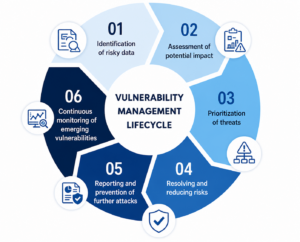
Step 1: Identification of risky data
Management of vulnerabilities begins by knowing your landscape. This comprises infrastructure, applications, and sensitive data. You should also maintain an asset inventory of systems.
Vulnerability scanning helps assess assets for weaknesses. The goal is to establish a complete understanding of potential vulnerabilities across the whole system.
This process is mostly automated as the speed and scale of manual tracking are inefficient in the face of rapidly growing threats.
Step 2: Assessment of potential impact
The next step is to analyze the potential impact of identified vulnerabilities. The results evaluate the severity of the threats based on how easy it would be to exploit the vulnerability.
The Common Vulnerability Scoring System (CVSS) is a system that is used to provide a consistent and unbiased assessment of the severity of security vulnerabilities in software. But it only provides a standard view of severity.
A thorough evaluation should determine how serious the impact could be if the vulnerability were to be exploited, taking context into consideration.
Step 3: Prioritization of threats
Sometimes, the threats are too many to remediate immediately. Prioritization identifies the order in which each vulnerability should be addressed.
This judgment differs in every organization. They address the high-risk ones and accept the low-risk vulnerabilities. A vulnerability may have a higher risk in one organization but may be a low risk in another.
Threat intelligence may also be used to know which vulnerabilities are being actively exploited. This helps enhance prioritization beyond severity scores.
Step 4: Resolving and reducing risks
This step handles the priorities that hold the highest priority. It can be done by replacing components, applying patches, or changing configurations. Additional safeguards can also be put into place, such as network controls or access restrictions.
Risk mitigation and risk remediation are two ways to address these risks. Risk mitigation involves using temporary measures to reduce the risk. The temporary measures are taken when a patch isn’t instantly accessible. This may include using a web application firewall or isolating the system from the network. Risk remediation is a permanent fix that includes applying software patches.
This does not eradicate all risks but reduces their exposure. The level of reduction is based on the organization’s risk tolerance.
Step 5: Reporting and prevention of further attacks
It is important for businesses to keep a record of the discoveries, the analysis, the remedies, and the reasons behind all the actions. They can refer to these if similar problems occur later.
This can also help spot recurring patterns so that organizations can improve their vulnerability management solutions.
Step 6: Continuous monitoring of emerging vulnerabilities
The process does not end with the remediation of vulnerabilities. Consistent monitoring is key to efficiently managing risks. It helps to be aware of system changes, emerging risks, and detecting new vulnerabilities.
Final Thoughts
Vulnerability management ensures that the IT system is continuously identifying, assessing, and remedying vulnerabilities to decrease the risk of threats and attacks.
Attackers are smart, so organizations have to be smarter. Companies should not give them the chance to exploit their sensitive data and operational processes by leaving themselves vulnerable.
Not only is it important to keep IT systems safe from cyber-attacks, but it is also important to learn from past attacks and acclimate to prevent further issues. It is a useful resource that all businesses should make proper use of.
Click here to read more blogs about cybersecurity.
FAQs
Q1. What are vulnerabilities in cybersecurity?
Answer: Malware, viruses, phishing scams, weak passwords, etc., are a few examples of vulnerabilities.
Q2. How does vulnerability assessment differ from vulnerability management?
Answer: The main difference is that vulnerability assessment is a one-time process, whereas management is a continuous process. It means consistently identifying, assessing, and remedying vulnerabilities.
Q3. How often should businesses conduct vulnerability scans?
Answer: Businesses should scan their IT systems for vulnerabilities at least quarterly, according to the Center of Information Security (CIS).
Recommended reading:
Key Pillars of Google’s Vulnerability Management System
Google Chrome Zero Day Vulnerability: All You Need to Know About
VoIP Security Vulnerability and Best Practices for Safer Communication