
Ever thought about whether your internet connection is secure while working remotely or simply accessing the public Wi-Fi for browsing the web? Unfortunately, not every network is safe. Cyber criminals are constantly trying to gain access to sensitive information, financial records, and any confidential data. VPN is meant to keep your information secure while transmitting data over the internet.
But do you know the key driver behind a VPN being a VPN rather than a proxy? It’s encryption. The concept of VPN encryption is something that many people would struggle to explain. It’s a method of converting your internet traffic into unreadable code, ensuring that only the intended recipient can access the information.
According to industry reports, the virtual private network market was valued at $58.16B in 2024 and $68.54B in 2025, which is expected to reach $354.20B by 2035. The stats depict the increasing VPN adoption rate, making encryption a must-have driver. To better understand what is VPN encryption, we have curated this blog. Dive in now to read the rest.
What is a VPN?
A virtual private network (VPN) is a technology that allows data and communication to and from your device to be transmitted securely through an encrypted tunnel to its destination. This creates a secure connection and hides your IP address and location, protecting your online activity from bad actors. A VPN keeps your browsing history anonymous and bypasses blocked websites.
What is VPN Encryption?
Encryption and VPN work together to provide a strong layer of protection for online privacy. VPN encryption is a method that transforms your internet traffic into unreadable code so that, even if intercepted, it cannot be read without the decryption key.
When traffic leaves your device, it is sent through an encrypted tunnel as a ciphertext to a VPN server, hiding the data from prying eyes. Without encryption, anyone monitoring your network traffic, including hackers, Wi-Fi providers, and ISPs, could view your online activity. Strong encryption is essential for any VPN.
How Does it Work?
VPN encryption creates a secure tunnel between your device and a VPN server. Here’s how it works:
1. When you access a website or application through a VPN, it encrypts the traffic using an encryption cipher. The connection request is then sent to a VPN server where it is decrypted.
2. After the device is authenticated, it encrypts all internet traffic with a high-level encryption protocol, like AES-256 or ChaCha20, rendering the data unreadable without the correct decryption key.
3. If someone intercepts your encrypted data, it is not possible to read it when it crosses the VPN tunnel to the VPN server.
4. The VPN Server decrypts your request and sends it to the website you are looking for. The VPN server's IP address is the only one visible on the internet, concealing your true IP.
5. The website then sends a response to the VPN server, which will encrypt the data and send it back to your device.
6. Finally, the VPN program decrypts the information on your device and lets you securely access the requested website or application.
VPN Encryption Secures Your Information From:
- Cybercriminals: They are always looking for weaknesses or opportunities to steal sensitive information. VPN encryption protects your traffic as it travels through the internet, making it unreadable for criminals.
- Internet Service Providers (ISPs): ISPs monitor your browsing activity. They have a close eye on the websites you visit, and the data you use.
- Public Wi-Fi Threats: Public Wi-Fi networks in hotels, airports, and shopping malls are less secure, making them targets for cybercriminals. VPN technology protects your data from attacks such as MITM and packet sniffing.
- Unauthorized Access: One major concern is that hackers can gain access to your system due to weak passwords or an insecure internet connection. VPNs prevent hackers from gaining access to your systems.
Common Types of VPN Encryption Algorithms
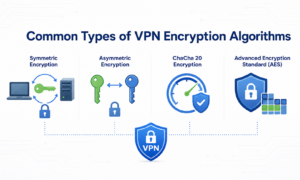
Below are the commonly used encryption algorithms in VPN-
- Symmetric Encryption: The Symmetric encryption algorithm uses the same key to encrypt the plaintext and decrypt the ciphertext. It’s simple and efficient, making it ideal for fast communication. Here, both the sender and the receiver should share the same key to communicate. Examples include Advanced Encryption Standard (AES) and Blowfish.
- Asymmetric Encryption: This method uses a key pair: a public key to encrypt data and a private key to decrypt it. This algorithm is slower than symmetric encryption but secure for establishing trust between devices with no prior communication.
- ChaCha 20 encryption: It is a commonly used encryption algorithm that is fast, secure, and ideal for securing your network on mobile devices. ChaCha is basically a stream cipher that encrypts data in a constant stream, bit by bit, and uses a 256-bit key for encryption and decryption.
- Advanced Encryption Standard (AES): AES is a widely used, sophisticated encryption standard used by cybersecurity experts. It has a 128-bit block size, regardless of the key size. The 256-bit encryption standard is considered highly secure because it breaks down 256 bits of plaintext into 256 blocks, making it difficult for hackers to steal information.
Types of VPN Encryption Protocols
There are different types of protocols that enable encryption. They differ in terms of speed, compatibility, and security.
- OpenVPN: OpenVPN is one of the most popular and versatile VPN protocols, supporting both TCP and UDP ports. This platform is well-suited for web browsing, live streaming, and more.
- IKEv2: Internet Key Exchange is a fast and stable protocol, ideal for mobile devices that need to switch between mobile data and Wi-Fi networks.
- WireGuard: WireGuard is basically a new protocol that’s built on a clean codebase as compared to OpenVPN. It has around 4,000 lines of code compared to hundreds of thousands. Less coding is beneficial as it reduces the chances of vulnerabilities in code.
- Point-to-Point Tunneling Protocol (PPTP): It is an outdated VPN protocol that offers fast connections; however, it is prone to security vulnerabilities due to weak encryption
Mistakes to Avoid When Using VPNs and Encryption
- Using weak passwords or using the same password across different accounts.
- Using public Wi-Fi networks without encryption and a VPN.
- Using an outdated VPN software that may contain unpatched security vulnerabilities.
- Not keeping a close eye on the DNS leaks. This can leave your internet traffic exposed to third-party DNS servers.
Are All VPNs Encrypted?
VPNs are designed to encrypt your internet traffic and protect your data. However, the encryption protocols and algorithms used can differ depending on the VPN provider. Thus, it is essential to choose the right VPN service provider that guarantees the maximum level of security and privacy for your online activities.
Summing It Up!
VPN encryption is a key pillar of online security and privacy. By creating an encrypted tunnel between your device and a VPN server, it keeps your internet traffic private, and data secure on public Wi-Fi, and masks your online identity. Thus, understanding what is VPN encryption and the key concepts around it, we can make a well-informed decision regarding choosing a VPN service.
To read more informative blog posts around the tech world, visit our website now.
FAQs
Q1. What are the four types of VPN?
Answer: The types of VPN are: Remote Access VPN, Cloud VPN, SSL VPN, and Site-to-Site VPN.
Q2. Which VPN uses AES-256 encryption?
Answer: ExpressVPN uses AES (Advanced Encryption Standard) with 256-bit keys, also called AES-256.
Recommended For You:
VPN Protection Limitations: What It Can’t Stop
How do VPNs (Virtual Private Networks) enhance online privacy and security?