
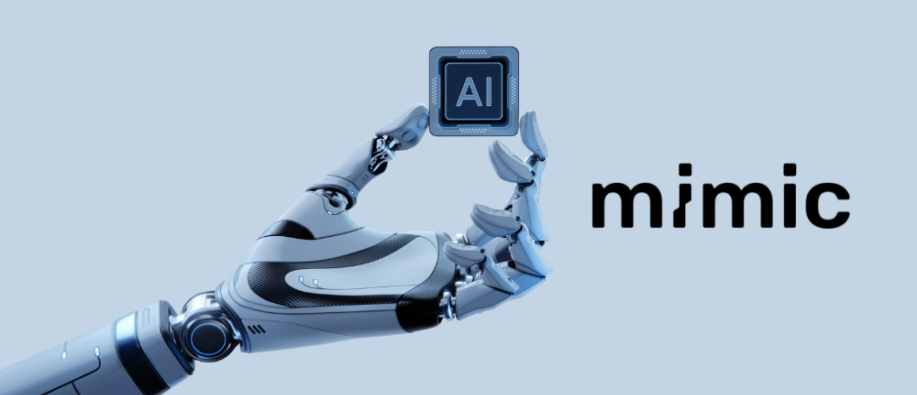
With the new hand M1 and wearable U1, mimic owns every layer of physical AI — hardware, data collection, and models — around one fixed point: the human hand.
ZURICH--(BUSINESS WIRE)--mimic robotics today unveiled the mimic hand M1, the first robotic hand purpose-built for industrial automation, and the mimic wearable U1 ("umimic"), an exoskeleton that lets people teach the robot simply by doing the task with their own hands. Both are designed and manufactured in-house, alongside a custom software stack. Together, they form an integrated platform for general-purpose dexterous manipulation.
mimic is a physical AI company located in Zurich, Switzerland and San Francisco, California, focused on a single goal: general-purpose dexterous manipulation. mimic believes the only way to solve it at scale is the full-stack approach: a vertically integrated system with full observability over its own hardware.
Unlike language models, robots have no internet-scale dataset to learn from. The largest source of real-world behavior that can be collected at scale today is video of humans using their hands — and that data only transfers cleanly if the robot shares the same form. mimic therefore keeps the human hand constant across its entire pipeline, from training data to deployed hardware. Owning every layer is what makes that possible.
The mimic hand M1 is a highly backdrivable, tendon-driven robotic hand. Its joints match the functional degrees of freedom of a human hand — including abduction and an opposable thumb — across 15 actuated degrees of freedom and 21 joints. Rather than pack motors into the hand, mimic drives the fingers through tendons from actuators in the forearm, so one system can cover the full range of human capability, from heavy payloads to fine manipulation, and survive years of industrial use. These joints let every actuator double as a force sensor: the M1 helps inform intelligence, not just execute on it.
The mimic wearable U1 is how mimic collects high quality data without a robot. Teleoperation requires fleets of robots already standing in target factories before delivering productive work, and even then operators fight latency and retargeting, never performing at their own dexterity. U1 removes both limits: a rigid linkage constrains the wearer's hand to exactly the motions M1 can perform, with tactile sensors, encoders, and a wrist camera in one-to-one correspondence with the robot's.
“The goal is really to collect robot data without needing the robot. Fundamentally robot teleoperation just does not scale. That’s why we have developed our wearable device," said Stephan-Daniel Gravert, CPO of mimic robotics.
"Owning the entire stack is one of mimic’s core bets. We purposefully design every component of the system in-house to maximize robot AI model performance," said Elvis Nava, CTO of mimic robotics.
mimic's anti-humanoid focus is deliberate. The complex, high-dexterity tasks it is after have stayed manual because automating them was either impossible or simply uneconomical — and nothing about that is solved by legs, a torso, or a face. It is solved by human-level dexterity, and human-level intelligence to direct it. Everything else adds cost, mass, and failure modes.
This platform is the foundation for mimic's work on Video-Action Models, following its pioneering research with mimic-video (see https://mimic-video.github.io/). mimic will soon release an update on what comes next.
About mimic robotics
mimic robotics is a physical AI company building general-purpose dexterous manipulation for factory floors. Headquartered in Zurich with a research unit in San Francisco, its team includes leadership and talent from Google DeepMind and Tesla Optimus, alongside researchers from ETH Zurich, MIT, and Stanford.
Read More:
Robot Cybersecurity: Why It Is Essential for Safe Industrial Operations