As cyber threats grow more sophisticated and attackers continuously refine their tactics, relying on a single layer of authentication is often no longer sufficient to adequately protect sensitive data, applications, and systems. Under such circumstances, organizations must adopt strategies that include multiple layers, securing data accessibility, and authentication.
In this regard, multi factor authentication (MFA) can be highly advantageous, adding additional security layers to data and applications. It eliminates the possibility of unauthorized access to any asset that has been protected with the tactic. MFA has been a top priority for businesses across industries for the last few years.
Over 87% of tech firms have adopted MFA solutions. As a result, the valuation of the global MFA market reached $24 billion in 2026 and is about to surpass $51 billion by 2031. In this blog, we will analyze MFA and understand why businesses should adopt it in 2026.
What is Multi Factor Authentication (MFA)?
Multi factor authentication is an identity verification method that involves two or more layers to authenticate an account or user, instead of just passwords. Here, unique codes via email, a secret question, and your biometrics like fingerprints are used as different layers to authorize account or user access. The strategy can be implemented to secure datasets, applications, user accounts, IT systems, local networks, and other digital assets.
MFA is among the best practices of identity verification, ensuring the right account gets access to a particular asset, eliminating the possibilities of unauthorized access, compromised credentials, and stolen passwords. The most common methods of MFA are the use of the following three factors-
- Knowledge factors: Something you know (passwords, PINs, security question answers)
- Possession factors: Something you have (phones, hardware keys, smart cards)
- Inherence factors: Something you are (biometrics, including fingerprints, facial recognition, retina scan)
Here, the protected application primarily collects and stores user information, including passwords, keys, and biometrics. The information is further protected with appropriate measures after registration.
Users, in this regard, often get confused between MFA and two-factor authentication (2FA); however, they have clear differences. While 2FA includes exactly two steps of identity verification, MFA usually includes two or more factors. MFA has also gone through several changes over the years. Previously, passwords or one-time passwords were shared through SMS. However, due to the surge of phishing attacks, the use of FIDO2 and passkeys has increased.
How Does MFA Work?
Multi factor authentication is an ID verification process, including multiple stages to authenticate an access request. Initially, the process collects login details of users through registration, which are used in the future whenever they try to log in or access. Here are the key stages of MFA to learn:
- Registration
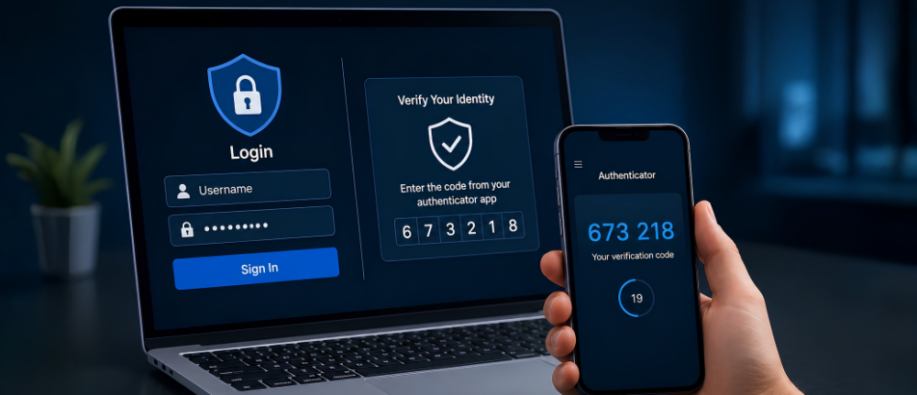
A user primarily creates an account with a username and password alongside enabling MFA. The account is then linked with further elements, such as email address, phone number, hardware, phone, authenticator app, and biometrics. All this information is saved and used whenever the user tries to log in or access the assets next.
- Username and Password
Once the credentials are set, users can request to log in or access through their unique username and password. However, this is just the first layer, which shows the knowledge factor- something that you know.
- Token or Passkeys
Once the login attempt is made through the username and password, the user gets one-time passcodes, time-based one-time passcodes, push notifications, and others on their linked email or phone number. It depends on possession-based factors, suggesting something you have.
- Biometrics
In the final layer, the process seeks the inherence-based factors, something you are. Here, fingerprints, voice recognition, facial recognition, or retina recognition can be used.
- Granted Access
After successfully passing all layers of MFA, users are granted secure access to the organization's digital assets, applications, and resources. This final stage ensures that only verified and authorized individuals can access sensitive information and systems.
Why Should You Consider MFA in 2026?
Multi factor authentication (MFA) in 2026 aims to protect confidential data, applications, user accounts, and other digital assets from cyber threats such as data breaches, stolen credentials, phishing attacks, identity theft, unauthorized access, and account compromise. For this purpose, it integrates multiple layers of identity verification before access is granted.
Undoubtedly, strengthening cybersecurity defenses only with passwords is an outdated and ineffective practice at present. In 2024, over 46% of American citizens reported having their password stolen. Another report shows that in 2025, more than 2.86 billion credentials were compromised. Such stats are an alarming indication of how going beyond passwords and adding extra layers of security is crucial.
With the popularity of hybrid and remote work environments across organizations, the graphs of data breaches, unauthenticated data access, and stolen passwords have surged. Organizations easily adopted such work modes but lacked while securing remote access. As a result, attackers easily target remote devices, steal passwords, access confidential data unethically, and create great operational and financial harm.
Alongside that, the advancements across AI, ML, predictive analytics, and automated operations have been highly beneficial for hackers and cyber attackers. These technologies help attackers automate attacks, broadening the impact.
MFA addresses these situations and reinforces the security posture of organizations and IT teams, enabling a zero-trust approach while allowing access to digital assets. Whether you are operating remotely or from the office, accessibility depends on the multi-step approach once MFA is implemented.
Benefits of Multi Factor Authentication in Business:
Strengthens Security Frameworks and Reduces Data Breaches:
The core benefit of MFA in business is enhanced security, leading to limited chances of unwanted data breaches. It further reduces risks in case of misplaced passwords, lost devices, or similar adversaries.
Helps Meet Regulatory Guidelines Across Regions:
MFA enables mandatory access control rules, necessary access only, enhanced data protection, and blocks unauthorized entry attempts. It helps businesses adhere to the leading regulatory guidelines, like GDPR, HIPAA, SOC 2, and others.
Enhances Audience Trust and Builds Credibility:
Advanced security measures of MFA establish trust among the employees of a firm, making operations seamless. This also boosts brand credibility outside the organization, building a positive brand image.
Addresses Human Errors and Phishing Attempts:
Human errors are a common cause of data breaches. Multi factor authentication reduces the impact of human error by adding multiple layers of security. Additionally, phishing attempts are far less likely to succeed because MFA requires additional verification steps beyond a username and password. As a result, even if a user accidentally shares credentials or clicks on a phishing link, a data breach would still require an attacker to bypass multiple authentication factors.
Challenges and Key Consideration:
Higher Costs: MFA strategies can be costly as they include the purchase and replacement of tokens, software, and others.
Implementation Complexity: The implementation of MFA across applications, accounts, networks, and systems can be resource-intensive, making the process extremely complex.
User Friction: Since MFA involves multiple steps for identity authentication, users need to spend extra time accessing datasets, accounts, apps, systems, and others. This often causes annoyance, leading to user friction.
Device Dependency: Most MFA solutions rely on external devices like smartphones and hardware tokens. It can make operations more challenging in an organizational setting.
Steps to Implement MFA in Business:
Step 1- Audit Your Current Systems
Identify which systems, apps, accounts, and networks require protection, including email, cloud servers, financial systems, and VPNs. Also, analyze which assets manage sensitive data and need to be prioritized.
Step 2- Choose the Right MFA Method
Adopt an MFA method according to your segmentation while enabling an authenticator app for employees, hardware keys for privileged accounts, and biometrics for highly sensitive devices. You can also adopt a mixed approach.
Step 3- Initiate Phased Rollout
Initiate the implementation in small phases, ensuring less complexity and convenience. In this stage, getting feedback will also contribute to further improvements in the process.
Step 4- Train Your Teams
Introduce MFA to your teams alongside explaining how to gain access seamlessly. Address their concerns for smooth implementation and operation.
Step 5- Mandate MFA for Seamless Security
Make MFA mandatory for every user and employee, as attackers can target anyone in an organization.
Step 6- Monitor and Optimize
Monitor the adoption across teams, analyzing failed login attempts, and malicious activities.
Aiming for Secure Business Operations with MFA!
The threat environment is continuously advancing with sophisticated attack strategies adopted by cybercriminals. In 2026, the challenges are increasing at an alarming rate with the increased usage of AI, ML, and predictive analytics. Data breaches and stolen passwords are occurrences that threaten user privacy almost every day. Under such circumstances, businesses need effective security approaches to safeguard their data, apps, systems, and networks from threats.
Multi factor authentication is among the cybersecurity best practices that enables a layered approach to protect your digital assets. The tactic is also evolving considering the changing strategies of attackers. Passwordless approaches and continuous verification are set to emerge in MFA practices. Hence, future MFA solutions will be smarter and more effective, making it a must-have strategy in your organizational cybersecurity framework.
We hope that the blog offered you an in-depth exploration of MFA. Read more SecureITWorld blogs to stay informed and protected in the tech-first era!
FAQs:
Q1. What are the four types of MFA?
Answer: Knowledge, possession, inherence, and location-based factors are the four types of MFA.
Q2. What is the MFA OTP code?
Answer: MFA OTP code is a 4 to 8-digit code that you often receive via email, SMS, or specific mobile app.
Q3. What is OTP vs TOTP?
Answer: OTP is a one-time password, and TOTP is a time-based one-time password.
Recommended For You:
Continuous Authentication: Securing Mobile Devices Ecosystem
Passwordless Authentication: The Smarter Way to Say Goodbye to Passwords!