Cybersecurity is a broad field and is evolving rapidly today. There is a vast cybersecurity glossary that novices to experts should understand to future-proof their organization’s security and digital assets. Be it your business, an enterprise, or a Fortune 500 company, an attack can cost you millions of dollars and cause complete business disruption. The global cybersecurity market is expected to grow from $227.59B in 2025 to $351.92B by 2030 with a CAGR of 9.1% during the forecast period.
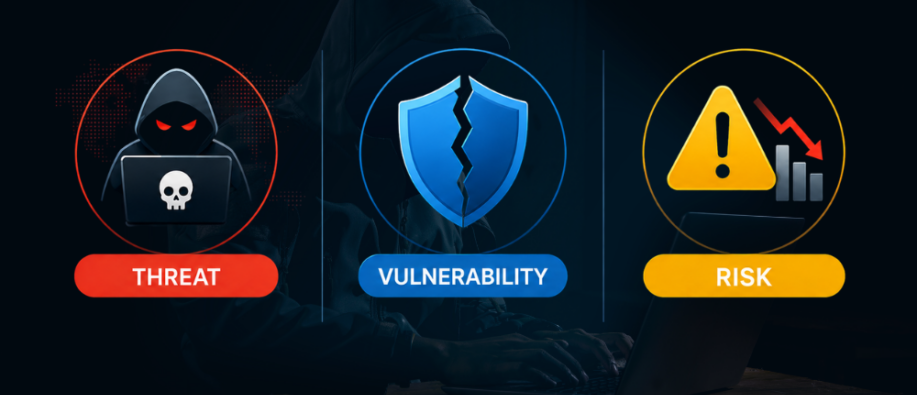
The three fundamental terms that many get confused about are threats, vulnerabilities, and risks. In this blog, we will take a closer look at the differences between threat vs vulnerability vs risk, alongside their types, and examples for better understanding. Let’s get started.
What is a Threat?
In plain English, a threat is basically any potential danger or action that can exploit, damage, or destroy a system, data, or people. It affects the confidentiality, integrity, and availability of data, systems, and assets.
In other terms, a threat is when an attacker has the opportunity or intent to harm or cause a negative impact on individuals, businesses, or assets. Threats can be natural, accidental, human-made, or deliberate. Some common types of cyber threats include ransomware, malware, and phishing attacks.
Types of Threats:
- Natural threats: As the name suggests, natural threats are floods, earthquakes, etc. that are not related to cybersecurity; however, they can cause damage to your important assets.
- Intentional threats: These include malware, phishing, and ransomware that trick users into revealing login credentials or other sensitive information. Any action that bad actors carry out purposefully.
- Unintentional threats: These threats are often due to human error. This includes failing to update the system, installing antivirus software, or clicking on any suspicious link that appears legitimate.
A Real-World Example:
An attacker clicks on a link in an email that appears to be from a trusted bank, and it tricks the users to reveal sensitive financial information. This phishing campaign is called the threat.
What is Vulnerability?
A vulnerability is similar to answering the question, “How could harm occur?” It is defined as the weakness or flaw in an organization’s attack surface that includes a system, application, or network that can be exploited by threats, hackers, or bad actors to gain unauthorized access and damage reputation. Vulnerability is the gap that hackers tend to exploit in your system.
Some of them are routine, like releasing something and following up by patching it. If left undiscovered, the weakness could be exploited in an attack. For example, in general, a vulnerability is leaving your door open when you are outside.
Now we will understand the types of vulnerabilities:
Types of Vulnerabilities
- Technical vulnerabilities: During the development process, bugs or errors may occur, and if not identified and fixed correctly, they can create security gaps.
- Human vulnerabilities: These can be caused by a lack of security awareness and training among employees in the organization.
Real-World Example:
The account owner does not have a multi-factor authentication enabled. This weak authentication setup represents the vulnerability that could compromise the account.
What is a Risk?
Where threats and vulnerabilities crash, is where risks come into the picture. A risk is basically the likelihood or the potential impact of a negative event happening and causing harm to an organization, its system, data, or users. The risks an organization faces can change over time due to internal and external factors.
Risks can never be eliminated; however, they can be managed wisely with a strong cybersecurity team. When it comes to cybersecurity, cyber risk involves assessing the likelihood that a threat will exploit vulnerability and cause harm. It is essential to understand the basics of risk assessment to defend against cyber risks. Below are some examples of risks:
Types of Risks
Cyber risks are categorized into:
- External: Cyber hazards that emerge outside the company include phishing, ransomware, DDoS attacks, and more.
- Internal: Cyber threats are caused by insiders. For example, employees in an organization may lack cybersecurity training and awareness.
Types of Cybersecurity Risks
- Loss of privacy
- Financial losses
- Loss of personal information
- Compliance risks
- Insider risk
Real-World Example:
Attackers can gain access to employee credentials. This way they can compromise the company’s systems and data. The likelihood and potential business impact of this scenario represent the risk of cybersecurity.
Threat vs Vulnerability vs Risk: A Breakdown of Differences
Below is the head-to-head comparison of differences between threat, vulnerability, and risk.
Factor |
Threat |
Vulnerability |
Risk |
| Definition | Anything that causes potential haram, for example a hacker trying to access sensitive information | A weakness in a system, internal controls, or others that gives bad actors an entry point for exploitation. For example, outdated software. | A situation where something valuable is exposed to danger causing harm, or loss. |
| Source | Can originate from hackers, cybercriminals, or insiders | Can originate from software bugs, outdated systems, human errors | Arises when existing threats can exploit vulnerabilities and affect valuable assets |
| Types | Malware, phishing, ransomware | Weak passwords, insecure API’s, excessive user privileges | Financial risk, reputational risk, compliance risk, and cybersecurity risk |
| Control | Cannot be controlled | Can be controlled | Can be controlled |
| How to identify | Antivirus software and threat detection logs | Penetration testing and vulnerability scanners | Identifying suspicious links, emails, repeat login attempts, a slow network, and more |
| Management Strategies | Threat intelligence and management | Vulnerability assessment and management | Cybersecurity risk management |
How to Prevent Threats, Vulnerabilities, and Risks?
Organizations, mainly SMEs, can overcome these cybersecurity factors by considering the points below:
- Update your system software regularly.
- Monitor your system constantly in real time.
- Do not click on any suspicious links in emails or pop-ups that may redirect you to a website.
- Keep an eye out for any third-party flaws in software, apps, or other applications.
- Evaluate your IT environment carefully.
How Does AI Affect Cybersecurity Threats and Risks?
Of course, artificial intelligence is rapidly shaping the global risks and threats for businesses of all sizes. On one side, AI is creating cyber threats such as phishing and deepfakes. On the other hand, AI is helping organizations enhance their defense strategies. AI can detect threats faster and identify potential issues that can harm a system.
Threat vs Vulnerability vs Risk: Never Ignore Cybersecurity Threats!
Vulnerabilities, risks, and threats are too expensive for organizations to ignore. They are important concepts in cybersecurity. Risk is the likelihood of a threat or vulnerability that’s going to happen. A threat is a potential source of harm that could exploit vulnerability and negatively affect an organization's assets.
Vulnerabilities are faults in security systems, applications, systems, or networks that an attacker can exploit. Hope the blog has helped you better understand the key differences between this cybersecurity glossary, threats, vulnerabilities, and risks, and how addressing them can help organizations strengthen their cybersecurity posture.
Stay updated with the latest blog posts around the cybersecurity landscape here.
FAQs
1] What are the seven types of cybersecurity?
Answer: The seven types of cybersecurity are: network security, application security, cloud security, endpoint security, data security, operational security, and identity and access management (IAM).
2] How can organizations reduce cybersecurity risks?
Answer: Organizations can reduce risk by identifying vulnerabilities, implementing access controls, applying security patches, and preparing incident response plans.
Recommended For You: