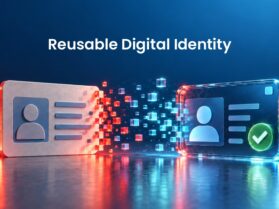
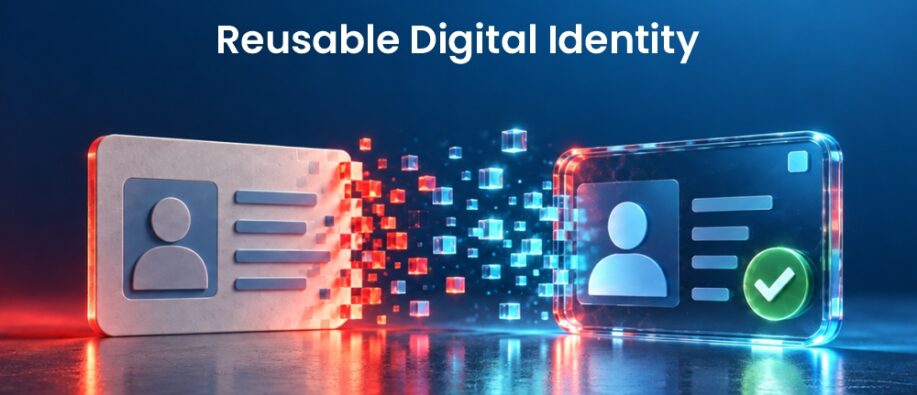
Many of us face the same frustration with identity verification. Even though our identity does not change, we are often asked to verify it again from scratch. You submit documents, complete verification checks, and wait for another organization to confirm information already verified elsewhere.
For example, you might verify your identity when opening a bank account, prove a degree to an employer, or confirm your age for an online service. Still, each organization usually requires its own verification process instead of creating something you can reuse elsewhere.
A reusable digital identity fills this gap. Instead of sharing the same documents repeatedly, people can use digitally verifiable credentials to prove information to different services.
This approach is becoming more technically mature. In May 2025, the W3C published Verifiable Credentials 2.0 as an official standard. It explains how digital credentials can be shared securely, with privacy protection, and verifiably.
What Is a Reusable Digital Identity?
A reusable digital identity becomes useful across services when another organization can independently verify a credential. It does not have to rely solely on a submitted document or a manual confirmation from the original user.
The process involves three main participants:
Issuer: Creates and issues the credential after verifying the relevant information.
Holder: Receives and controls the credential.
Verifier: Checks the credential when proof is required.
This issuer–holder–verifier model is part of the W3C Verifiable Credentials framework.
Consider a university-issued qualification credential. The university acts as the issuer, the graduate holds the credential, and an employer can act as the verifier.
When the graduate presents the credential, the employer can verify the claim directly instead of relying on an unverified certificate image.
The key difference is that digital identity does not depend on digitally stored documents. It depends on verifiable, portable credentials.
How Does Reusable Digital Identity Protect Privacy?
Reusing a credential does not necessarily mean revealing all the information it contains. To complete a particular transaction, a service may need only specific information. This means the holder does not have to disclose unnecessary details.
For example, an age-restricted service may need to confirm that a person meets a required age threshold. It may not require their full address or other identifying information.
With selective disclosure, the person can prove the required age without sharing information the service does not need. For reusable digital identity, this approach can reduce the amount of personal information a service receives and retains during a particular interaction.
How Reusable Digital Identity Works in Practice
A simple reusable-identity journey can be divided into five stages.
Step 1: Establish identity
A person first goes through an identity-proofing process with an appropriate provider.
Identity proofing establishes evidence that an applicant is who they claim to be. NIST's current Digital Identity Guidelines, SP 800-63A-4, describe requirements for identity proofing and enrollment and define different identity assurance levels.
This is the stage where you may examine evidence such as government identification or other authoritative information.
Step 2: Receive a credential
After verifying the relevant facts, an authorized issuer creates a digital credential.
Consider the example below:
Credential: Professional certification
Issuer: Recognized certification organization
Holder: The individual
Claim: Certification is valid until a specified date
The credential is digitally secured so that a verifier can check its authenticity and integrity.
Step 3: Store the credential
The credential can be stored in a compatible digital identity wallet or another appropriate credential-management environment.
Instead of keeping a folder of PDFs and repeatedly uploading them, the user has a structured digital representation of the credential.
Step 4: Present the required proof
Suppose the credential holder applies for a service that requires proof of professional certification.
The service requests the relevant credential or claims.
The holder authorizes the presentation.
The wallet or credential system provides the requested proof.
Step 5: Verify the presentation
The service checks whether the credential and its associated proofs satisfy its verification requirements.
This can involve checking cryptographic integrity, issuer information, validity, and status.
This is much more reliable than trusting an uploaded image that only appears to be genuine.
How Do Services Check Whether a Credential Is Still Valid?
A service does not have to assume that a credential is valid simply because it was issued in the past. While verifying it, the service can check the credential's current status to determine whether it is still valid, expired, or revoked.
The exact method depends on how the credential system is designed. When a credential is presented, the verifier checks its current status to confirm whether the service can still accept it.
A verification process can therefore consider questions such as:
- Who issued the credential?
- Is the credential structurally valid?
- Has its cryptographic protection been compromised?
- Is the credential currently valid?
- Has it been suspended or revoked?
- Does the credential meet the verifier's policy?
- Is the presentation associated with the intended holder?
The exact verification architecture depends on the credential ecosystem and implementation.
Where Do We Use Reusable Digital Identity
The strongest use cases for reusable digital identity aren't defined by industry. They are defined by situations where the same verified fact needs to be proven repeatedly to different organizations.
Here are a few practical, often-overlooked examples.
1. A graduate applying to multiple companies with one verified qualification
A university graduate applying for jobs may have to prove the same degree multiple times. With reusable credentials, the university could issue a digitally verifiable degree credential to the graduate's wallet.
Instead of emailing certificates or uploading scans multiple times, the graduate can present the relevant credential to each employer.
The interesting part is not that the degree became digital.
The university's verification can potentially be reused across multiple independent hiring processes.
2. Proving age without handing over an entire identity document
Age verification is a practical example of reusable digital identity.
An online service may only need to confirm whether a customer meets an age requirement, rather than collecting their full identity document, including
- Name
- Date of birth
- Photograph
- Nationality
- Expiry date
- Other identifying information
A suitable credential system can confirm the required age threshold without automatically exposing the entire identity record.
This illustrates one of the most important ideas behind reusable digital identity:
Verification does not always require full disclosure of credentials.
Where Reusable Digital Identity Still Faces Challenges
Despite its potential, reusable digital identity still faces several practical challenges:
Cross-Platform Credential Interoperability
Reusable credentials need to work across different platforms. If systems use incompatible standards, then users may still have to repeat verification.
Trust Between Credential Issuers and Verifiers
Services need to know whether a credential comes from a trusted issuer. A strong trust framework helps verify that the credential is genuine and valid.
Limited Acceptance Across Services
A credential is only useful when services accept it. Wider adoption is needed for reusable digital identity to become practical in everyday transactions.
Privacy and Unnecessary Data Exposure
Users should not have to share more information than a service needs. Privacy-focused credentials can help limit unnecessary exposure of personal data.
User Adoption and Everyday Usability
People need a simple way to store and share their credentials. Complicated wallets or confusing verification steps can discourage adoption.
Final Thoughts!
Reusable digital identity offers a different way to approach online verification. Users can carry verified credentials and present them when a service needs proof. This can reduce repeated checks and make verification more convenient. People are more likely to adopt it when sharing credentials feels simple and secure. As more services accept verified credentials, it can become a practical part of everyday digital verification.
FAQs
Q1. Is reusable digital identity the same as a digital ID?
Answer: No. A digital ID represents a person's identity in digital form. Reusable digital identity goes further by letting you use verified credentials across different services..
Q2. Which technical standards do reusable digital identity use?
Answer: Reusable digital identity uses several standards. Key examples include W3C Verifiable Credentials, Decentralized Identifiers (DIDs), OpenID4VCI, and OpenID4VP.
You May Also Like:
How Secure is Automotive Digital Identity?
How to Protect Your Digital Identity Online? The Best Practices