
A suspicious login can be the first sign of a major cyberattack. When a security alert appears on an analyst's screen, the team must determine whether the activity is legitimate or indicates a compromised account.
Inside a modern Security Operations Center (SOC), investigating such alerts involves more than reviewing notifications. Analysts examine login records, compare activity across security tools, and investigate anything that appears unusual.
By reviewing data from multiple sources, they can assess the threat, verify whether an account has been compromised, and take appropriate action.
What Happens Inside a Security Operations Center?
The role of a security operations center is to monitor an organization's digital environment for signs of cyber threats. Its scope may include endpoints, corporate networks, cloud infrastructure, and business applications.
Security events from these systems provide visibility into user activity and potential attacks. SOC analysts investigate suspicious events and coordinate responses when they identify a threat.
Some organizations operate an in-house SOC, while others use managed security service providers. Both models require clear responsibilities and reliable incident-handling procedures.
The Three Pillars of a Modern SOC
A modern security operations center depends on three major components: People, Processes, and Technology. Together, these pillars help organizations identify threats, investigate suspicious activity, and coordinate an effective response.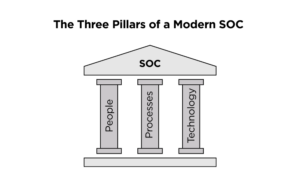
1. People: Who Runs Security Operations?
A modern SOC relies on specialists who investigate alerts and make decisions based on evidence. Their responsibilities vary with experience and the organization's operating model.
SOC Analysts
Tier 1 analysts perform initial alert triage. They review available context and determine whether an alert requires further investigation.
Tier 2 analysts examine more complex cases. They check information across systems to assess the scope and potential impact of a compromise.
Senior analysts may investigate advanced threats and develop detection rules. Their findings help the SOC improve its ability to identify suspicious behavior.
Threat Hunters and Incident Responders
Threat hunters search for malicious activity that existing detection rules may overlook. They investigate unusual patterns and test scenarios to uncover potential attacks.
Incident responders manage confirmed incidents. They coordinate containment and recovery with IT administrators and other stakeholders.
SOC managers oversee staffing and operational priorities. They also coordinate escalations and ensure that serious incidents reach the appropriate decision-makers.
2. Processes: How Does a SOC Handle Security Incidents?
Documented workflows help analysts handle security events consistently. They also define when a case should be escalated and what actions are appropriate at each stage.
Alert Triage and Investigation
Analysts evaluate alerts using factors such as asset criticality and the potential impact of suspicious activity. They gather evidence before deciding whether to escalate an incident.
An unfamiliar login alone may not indicate a cyberattack. However, a login followed by unusual privilege changes or access to sensitive files may justify deeper investigation.
Escalation and Containment
When evidence indicates a genuine compromise, analysts follow established incident response procedures. The response may involve disabling an account or isolating an affected device.
Escalation rules define who can approve actions that may disrupt operations. This is particularly important when containment could affect critical business services.
Evidence and Recovery
Analysts document their findings and preserve important logs. These records support forensic investigations and help establish the sequence of events.
Once the immediate threat is under control, the team verifies that affected systems are safe to restore. The investigation should also identify weaknesses that allowed the incident to occur.
3. Technology: Tools Used in a Modern SOC
Security tools provide information that helps analysts track activity across multiple systems. Each tool contributes a different capability to threat detection and investigation.
SIEM for Security Event Correlation
Security Information and Event Management (SIEM) platforms collect and correlate logs from multiple sources. They help identify relationships between events that might otherwise appear unrelated.
For example, a SIEM system may correlate repeated authentication failures with an unusual successful login. Analysts can then investigate the sequence as a possible account compromise.
EDR and XDR for Threat Investigation
Endpoint Detection and Response (EDR) tools help analysts monitor activity across devices and servers to identify potential threats. They also support investigations into suspicious behavior and possible signs of compromise.
Extended Detection and Response (XDR) platforms correlate signals across supported security sources. This helps investigators connect device activity to related identity or network events.
SOAR for Workflow Automation
Security Orchestration, Automation, and Response (SOAR) platforms help automate repetitive investigation tasks. For example, they can enrich an alert with threat intelligence or automatically create an incident case.
By automating routine tasks, SOAR helps analysts save time and focus on higher-priority work. However, high-impact actions still require appropriate safeguards and human approval.
A SOC Workflow: From Suspicious Login to Containment
Consider an employee account that signs in from an unusual location and then attempts to access sensitive files. The SOC investigates the activity to determine whether the account has been compromised.
Step 1: Detection
The SIEM identifies a suspicious sign-in alongside unusual file activity and generates an alert for investigation.
Step 2: Triage
A Tier 1 analyst checks the user's recent activity and the affected systems. The available evidence does not match the account's expected behavior, so the case requires further investigation.
Step 3: Investigation
A Tier 2 analyst reviews identity logs and device activity more closely. The evidence suggests that an unauthorized person may have accessed the account.
Step 4: Containment
The incident responder terminates the user's active sessions and resets the compromised credentials. The team also checks whether the attacker accessed other systems.
Step 5: Review
Analysts document their findings and identify any detection gaps. The security team adjusts monitoring rules as needed to improve future detection.
How Do You Measure SOC Performance?
SOC metrics help managers identify operational weaknesses and evaluate the effectiveness of security operations.
Mean Time to Detect (MTTD) and Mean Time to Respond (MTTR)
Mean Time to Detect (MTTD) measures how long it takes to identify a threat.
Mean Time to Respond (MTTR) tracks response speed, although its exact definition can differ by organization.
False Positives and Alert Backlogs
Teams should also track false positive rates and unresolved alert backlogs. Too many harmless alerts can distract analysts and make it harder to focus on genuine threats.
Evaluating SOC Effectiveness
Metrics need to be viewed in context. Responding to alerts quickly does not always mean security is effective, especially if important evidence is missed.
Incident severity and response quality provide a more complete picture of the security team's performance.
Final Takeaway
A modern Security Operations Center (SOC) needs to keep evolving as technology and cyber threats change. Its effectiveness depends on how well its people, processes, and technology work together.
Skilled analysts need reliable evidence and clear procedures to make sound decisions. That coordination helps organizations detect threats and respond before incidents cause greater damage.
FAQs
1. What is the difference between a traditional SOC and a cloud-native SOC?
A traditional SOC mainly supervises on-premises systems, such as physical servers, network devices, and corporate data centers. It relies on tools designed for traditional IT environments.
A cloud-native SOC is built to monitor and protect cloud environments. It collects and analyzes security data from cloud services, cloud applications, and cloud infrastructure. It is designed to handle the scale and speed of modern cloud environments.
2. How is artificial intelligence changing Security Operations Centers?
Artificial intelligence (AI) is helping Security Operations Centers analyze large volumes of security data, identify unusual patterns, and prioritize alerts for investigation. However, human oversight remains important for validating AI-generated findings and making critical security decisions.
You May Also Like:
Why Incident Response Plans Fail During Real Cyber Attacks
Cybersecurity Metrics Measuring the Safety of Your Data
The Rise of the AI-First SOC and Its Revolutionary Impact on Cybersecurity Threat Detection