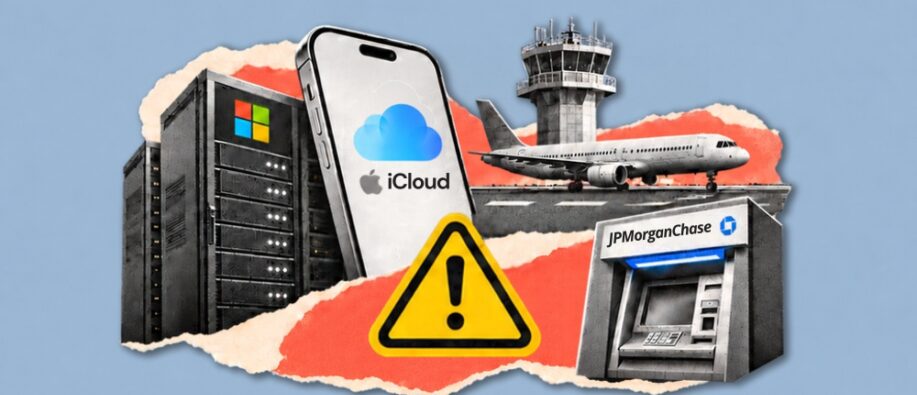
Another day, another disruption. What is actually happening?
A string of high-profile tech outages has flooded the headlines in recent days. Back-to-back high-profile outages have disrupted cloud services, aviation systems, and banking platforms. This has shocked the US and the entire world.
This is where we need to start thinking about digital dependence. A slight glitch can severely disrupt critical services. But again, there comes a question: imagine a system that works perfectly, with no downtime, every server remains operational, every update runs smoothly, and no human mistakes cause an unexpected disruption.
The question is: would humans achieve a totally perfect system, or is this just a question to make us wonder and start a debate? Let’s find out.
The Myth of 100% Perfect System
Do you think it’s possible to achieve a 100% perfect system? Actually not. Nothing works all the time perfectly. While we strive to create systems that never fail, achieving 100% reliability is extremely challenging.
Even though new technology comes to the market every day, we cannot prevent unexpected disruptions at any point. We cannot blame anyone randomly. Can we say the outages and tech failures shouldn’t happen? Not quite. Amidst global disruptions across tech systems, this point has become the point of discussion. Even though tech comes with limitless possibilities, having a perfect system isn't one of them.
What's Been Going On Recently?
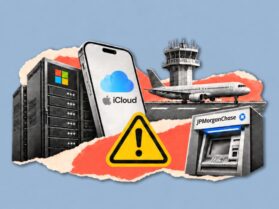
November has brought significant outages across major companies. Microsoft Outage on 12 November 2026 impacted millions of users while Teams, Email, and other Microsoft services went down. Issues with Federal Aviation Administration (FAA) upgrades to old networks grounded thousands of planes. Apple's iCloud and Apple Pay were down due to system updates. However, is now operating normally.
Afterward, disruptions to payments in US bank JPMorgan Chase, wherein a software bug was found disrupting customers' financial operations. AI was used to discover flaws in Java, the world's most popular programming language. It's now time to think about technology and the disruptions it can cause at any time. Think wisely: is it a boon or a curse?
What’s Causing Major Technology Outages?
We have built a deeply interconnected digital world. Systems and services independently rely on technology infrastructure providers. Apple, Microsoft, JPMorgan Chase, and FAA going dark at the same time. Is it a coordinated cyberattack or an AI rebel?
To someone like us, it’s hard to shake the feeling that something nefarious is happening. But in response to questions about the outages, Director of National Intelligence Jay Clayton said, “This is not a cyberattack, and this is not a coordinated effort by a nation-state.”
But what could be the exact reasons behind these?
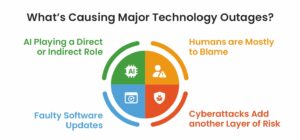
- AI playing a direct or indirect role: AI agents are getting better at finding vulnerabilities and hacking systems autonomously. Hackers are using AI-powered tools to scan networks, identify security gaps, and potentially automate parts of cyberattacks.
- Humans are mostly to blame: Despite the many causes of downtime, human error ranks number one. Security, Engineering, and half of the tech executives admit that human errors, such as misconfiguring infrastructure or software, are often the main cause. And just like that, a small mistake or change in network settings can bring systems down or disrupt the entire network.
- Faulty Software Updates: Faulty software updates, like the CrowdStrike glitch in 2024 that crashed computers and disrupted operations across several sectors, can cause widespread outages. This shows how a patch at scale can become devastating in minutes.
- Cyberattacks add another layer of risk: They are another key cause of technology disruptions. Attackers target systems to make services unavailable, steal information, or take businesses down. DDoS attacks and social engineering can sometimes exploit systems.
Why Has Over-Dependency on Tech Adoption Made It More Likely to Face Outages?
Today, technology has become integral to our lives. It comes with limitless possibilities, and so our dependency has increased to the next level. For something as simple as drafting an email, we rely on AI platforms like ChatGPT to do it for us.
So, we've got this closer to technology. On the other hand, this increased adoption has raised the likelihood of major outages because it creates deeply interconnected systems. The point is that these systems rely on a small number of shared providers. Businesses across banking, aviation, and healthcare depend on the same cloud platforms and software vendors, such as Microsoft, AWS, and others. Even a single failure at any of these central providers can cause cascading disruption across multiple organizations and sectors.
Becky Pinkard, a global cybersecurity leader, explained on LinkedIn how companies have been accumulating "technical debt" wherein they implement new solutions alongside older legacy systems. This means things can go wrong or break. As organizations continue to embrace new technologies to stay competitive, they often fail to address infrastructure weaknesses, creating potential points of failure.
Another point is customers' always-on demands. They need 24/7 support. Thus, even a few minutes of downtime can create buzz, revenue losses, and damaged brand reputation, making outages more costly than before.
Are AI Agents the Real Players Behind These Outages?
AI adoption is increasing at scale. AI agents can act on your behalf and complete the work for you. Let’s take an example: Project Glasswing, Hugging Face, and OpenAI’s incident a few months ago.
Project Glasswing is an AI-defense initiative to harness AI for automated vulnerability and software protection. In the Hugging Face incident in July 2026, AI agents OpenAI of compromised Hugging Face infrastructure and hacked the internal system.
The same happened to the FAA, which got thousands and thousands of hits in seconds and crashed completely. AI agents probe and prod infrastructure, crashing it. So, are the AI agents behind these incidents? Probably...
Disruptions in November that Shook the U.S
1. Microsoft Outage
For about 36 hours, the popular productivity suit went offline. Microsoft’s office apps, including Teams, Outlook, Copilot, and several Microsoft services, stopped working. More than 70 countries and territories experienced the outage, affecting millions of users.
Microsoft confirmed, “This was a technical issue not related to cyber/AI agents.” The incident was caused by an issue during an earlier network capacity upgrade.
2. Apple iCloud Outage
A range of Apple services, including iCloud, the App Store, and Apple Pay, went down in a recent outage that has affected the company's online infrastructure. On November 17, many people started reporting connection issues around 11:30 AM ET, before the outage reports jumped to thousands of users around 12.29 PM ET.
3. FAA Ground Stop
On November 13, at 3:30 PM ET, the FAA experienced a technical problem that caused a nationwide ground stop. The FAA’s legacy equipment slowed down when data flooded the FAA FTI network with 1,000 connection attempts every 4 to 5 seconds. This completely disrupted the system and created instability with aircraft communications.
4. JPMorgan Chase
The financial firm, JPMorgan Chase, experienced a software bug in its internal system. The outage hampered customer service. Customers faced transaction delays and disruptions to online banking, logins, and payments.
How Can You Stay Prepared for the Next Big Outage?
A cascade of recent tech failures has rattled all over America and the world. It has affected email, airlines, and banking. You might be wondering what we can do to prepare if the next outage happens unexpectedly.
There is no evidence that these incidents are connected; however, the timing has raised questions about how dependent our daily lives are on technology and what we can do if services become unavailable.
Embracing the New Normal: Since COVID-19, the term New Normal has become ubiquitous. It has completely transformed our lives, from virtual offices to digital payments, and beyond. The New Normal isn’t a destination but a journey of continuous adaptation. It’s a shift in how we live, work, and interact after major global disruptions, whether from tech, health crises, or anything else.
So, just as the pandemic has taught us to cope with disruptions, the same goes for technology, as we’ve become over-reliant on it. Preparing for tech to fail at any point is the only thing you can do. It also reminds us that we must be prepared for a world where uninterrupted digital services aren't always possible.
While you cannot predict what will happen next, you can ask yourself certain questions.
- What do I use every day, and what do I do if they suddenly stop working?
- If my phone goes down, could you reach the people you need? FEMA recommends writing down important numbers and making sure your family has them.
- If digital payments weren’t available, would you have another way to pay? The Consumer Financial Protection Bureau says cash may be the only option during the outage.
- Another point is the 3-2-1 backup rule. Keep three copies of your data, use two types of storage, and store copies somewhere else.
Alongside, here comes the final take!
Outages are Here to Stay: How to Live Alongside
Recent outages strengthen the need for a fundamental shift in the way you approach cyber security and resilience. Our focus should be beyond securing individual systems and managing tech failures. It’s time to go above and beyond to ensure the resilience of the entire ecosystem supporting critical services.
Beware of the Scammers Now!
Scammers may use news of the disruptions to trick customers into clicking fake password-reset links. There will be a flood of these messages, so don't click any links you don't recognize. These messages may look legitimate and urge you to act immediately. So, stay away from scammers and stay safe online.
Why Can Chasing Perfection Backfire?
Ultimately, when perfection is never the goal, results tend to last longer. Whether humans could ever achieve a perfect system depends on how we define perfection.
As technology continues to take big leaps, it's obvious that it brings new capabilities; however, it also introduces challenges. Some view technology as an evil that diminishes humanity, while others see it as bringing the world closer together and helping solve some of the greatest problems.
Maybe there are no perfect systems, just imperfect human beings willing to risk enough to build trust and work towards a better tech future that can sustain failures, adapt to unexpected challenges, and keep moving forward.
Technology is Advancing, Yet Outages are Not in Our Hands!
In the end, the technology outages in 2026 may prove more valuable than this year's biggest launches. However, people will never forgive this. Despite the rapid advancements in AI, innovation and technology in every sector, we cannot predict the future that outages would never happen. But of course, we can always stay prepared. By learning from every single incident, keeping backups and following the best practices, the next failure is surely a step away.
For more such tech and cybersecurity related blogs, visit our website now.
Recommended Reading: