ExtraMile by SecureITWorld is an in-depth interview series that evaluates the emerging tech and cybersecurity practices, challenges, and future perspectives. In each session, we connect with leading industry voices in cybersecurity and offer expert-led insights.
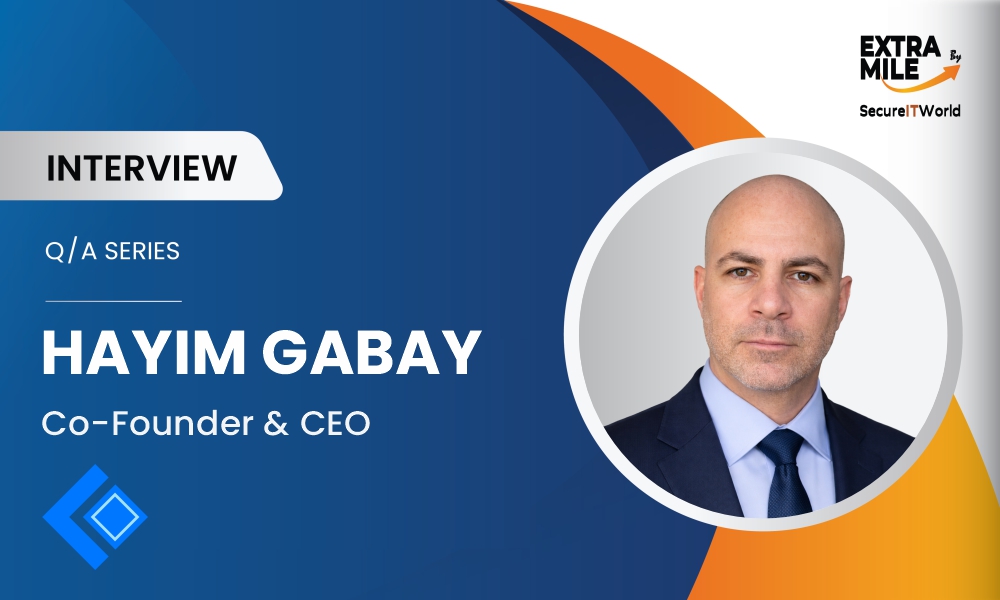
We are delighted to feature Hayim Gabay, the Co-Founder and CEO of CyBox Security, in today’s Q&A session. The firm works as a virtual security team for software development and security teams while addressing sophisticated security threats in the AI era. It simply transforms disordered security signals into a clear and prioritized workflow that teams can easily execute.
Hayim is a technical, product-driven builder who founded CyBox, observing the changing software development dynamics and emerging security challenges. In the conversations, he will highlight this significant change and AI’s dramatic role in it. Our guest will further share how CyBox Security is consolidating signals, reducing noise, and addressing vulnerabilities with appropriate remediation.
So, let us understand the changing challenges in software development in the AI era and learn appropriate strategies to tackle them.
Welcome, Hayim; we’re glad you could join us today!
1. You have had an extensive professional journey from being a tech leader to founding a cybersecurity firm. Walk us through your major career highlights.
Hayim. My journey has consistently been about bridging complex technology with practical outcomes. I worked across technical, platform, and product roles in high-scale environments, and I kept learning the same lesson: speed is only an advantage if teams can maintain trust in what they ship. As systems became more distributed and delivery cycles accelerated, organizations adopted more tooling and generated more dashboards, but decision-making often did not get easier, especially in security.
Looking back, the pattern I see is that security becomes a decision and execution problem, not just a detection problem. Many teams can find issues, but fewer teams can consistently prioritize the right work, assign ownership, and make steady remediation progress. Over time, the backlog becomes operational security debt.
In the AI era, the gap became impossible to ignore. AI increased the volume and velocity of code changes, but security capacity and human attention did not scale at the same pace. That realization led me to build CyBox Security: a Virtual Security Team that consolidates signals, reduces noise, and helps teams prioritize and execute remediation without slowing delivery.
2. CyBox Security is set to revolutionize the cybersecurity space with advanced technologies in the AI era. What motivated you to establish the firm, and what are your goals?
Hayim. The motivation came from a practical gap I saw across organizations: development velocity increased dramatically, but security workflows didn’t evolve fast enough. AI accelerated shipping and increased the volume of changes, while security attention remained limited. Teams became overwhelmed by findings and conflicting signals, and they struggled to decide what truly matters right now.
CyBox was founded to close that gap by giving teams a Virtual Security Team: turning scattered security signals into a clear, prioritized workflow they can act on. We focus on clarity over noise, helping teams understand what matters, why it matters, and what to do next, so they can make steady remediation progress without slowing delivery.
Long term, our goals are to shift the market from detection-heavy tooling to decision and execution: a prioritized remediation plan teams can actually complete, guided fixes and automation where safe, and audit- or deal-ready evidence that helps teams prove readiness. In short: helping teams move fast without losing trust in what they ship.
3. As a tech and cybersecurity thought leader, which threats do you think are the most dangerous for organizations today, and how do businesses prepare themselves?
Hayim. The most dangerous threat today is the combination of complexity, fragmentation, and speed. Organizations run more code, services, dependencies, and cloud infrastructure than ever, while relying on disconnected tools that generate large volumes of alerts without clear priorities. That leads to alert fatigue, missed critical risks, and blind spots.
In the AI era, the rate of change increases further. When teams ship more frequently, the window for manual review shrinks and the backlog grows faster. If everything looks urgent, nothing gets treated urgently.
The strongest organizations treat security as an operating discipline: clear ownership of findings, integrated remediation workflows, measurable progress tracked over time, and risk communication that executives and customers can understand without decoding technical jargon.
4. Have AI-driven technologies led to increased vulnerabilities in modern security environments? How do organizations stay vigilant while adopting AI?
Hayim. AI increases risk even as it increases productivity. On the development side, AI accelerates code generation and change volume, reducing time for careful review and increasing the chance of insecure patterns. Security capacity and human attention don’t scale linearly with code output. On the attacker side, AI lowers the cost of automation, speeding up reconnaissance, improving phishing quality, and increasing the scale of exploit attempts.
The answer isn’t avoiding AI, it’s adopting it responsibly. I summarize our approach as “fighting speed with clarity”: automate what you can, reduce investigation overhead, and focus teams on fixing what truly reduces exposure without slowing innovation.
5. CyBox is a unified platform that addresses security issues in code, cloud, and runtime. How does the unified approach construct a powerful security infrastructure, and how will organizations be able to solidify their security efforts with CyBox's solutions?
Hayim. Traditional security is siloed: separate tools for code, dependencies, cloud configuration, and runtime. These systems rarely connect, so teams receive fragmented signals and conflicting priorities. That makes it hard to answer basic questions like what’s actually risky in our environment right now, where exposure exists, and what should be fixed first.
A unified approach creates stronger security because it improves context and prioritization. When signals are connected, teams move from “we found something” to “we understand what it means for our environment and our business.”
CyBox supports this by consolidating signals into one prioritized view that teams can act on. It helps engineers focus on what matters, why it matters, and what to do next, while tracking remediation progress over time. Leaders can communicate posture clearly without decoding fragmented technical reports. The result is fewer blind spots, better prioritization, and consistent remediation at modern development velocity.
6. What is the significance of compliance at present while prioritizing data security? How does CyBox stay aligned and compliant with the leading security regulations?
Hayim. Compliance has become a prerequisite for trust. For many organizations, especially those selling to enterprise customers, frameworks like SOC 2 and ISO 27001 are required to close deals and demonstrate operational maturity. The challenge is that many companies treat compliance as a one-time snapshot, while modern software changes continuously, especially in an AI-accelerated environment.
The shift is toward continuous compliance: security workflows that generate evidence and progress over time. CyBox supports this by connecting day-to-day engineering activity to what auditors and enterprise buyers care about clarity, consistency, and proof of progress. When risk is prioritized, ownership is clear, and remediation is tracked, teams can demonstrate controls are maintained continuously. Compliance becomes a byproduct of disciplined security operations, not a periodic fire drill.
7. Give us an overview of CyBox's SAST Agent. How does it track insecure code patterns before release?
Hayim. CyBox includes static analysis capabilities that help teams catch risky patterns early before they reach production. Static analysis can detect issues such as injection risks, unsafe input handling, insecure authentication logic, and other vulnerable patterns.
The challenge with many tools isn’t detection it’s usability. They often generate long, noisy reports that are difficult to triage, so findings pile up and become security debt. CyBox focuses on clarity and contextual prioritization. We don’t just report that an issue exists, we help teams understand whether it matters in their context and where fixing it will reduce the most risk.
The goal is a developer-first experience that supports action: what the issue is, why it matters, and how to address it without turning security into a bottleneck. Over time, teams fix risky patterns earlier, when remediation is cheaper and faster, and leadership can see consistent progress.
8. Establishing startups requires a strategic approach altogether. How will you inspire leaders and professionals to build startups that actually meet the changing market demand?
Hayim. My advice is to build for real pain, not hype. In the AI era, building is increasingly democratized many teams can ship faster. That means speed alone isn’t a durable differentiator. Trust is. Customers want confidence that what they adopt will work reliably, fit into their workflow, and reduce uncertainty rather than add complexity.
Founders should obsess over the user’s operating reality and design for adoption: minimize friction, focus on measurable outcomes, and integrate into how teams already work. I also encourage thinking in trigger moments audits, enterprise deals, incidents, or hiring gaps because that’s when organizations buy.
The best startups don’t just solve problems—they remove uncertainty and give teams the confidence to move faster. That’s what creates lasting value.
Discover More In-depth Interviews: