

The digital presence of organizations is growing rapidly, and hence, the external attack surface is growing faster than ever. The list of external attack surface components, including cloud services, domains, APIs, subdomains, web applications, and exposed ports, continues to grow, often faster than security teams can track them.
In this extended digital world, businesses often unknowingly expose their internet-facing assets. This setback in visibility creates significant security risks. As a result, External Attack Surface Management (EASM) solutions require identifying, monitoring, and securing exposed assets.
According to market sources, the attack surface management market was valued at USD 980.4 million in 2023 and is expected to expand at a CAGR of 31.3% between 2024 and 2030.
Let's figure out through this blog exactly how External Attack Surface Management (EASM) products work, how they uncover unknown assets, and how they identify vulnerabilities.
Understanding the Attack Surface
An attack surface is the set of all possible entry ports through which digital criminals gain access to an organization's systems, data, or networks. Cloud platforms, websites, APIs, remote access tools, email systems, and IoT devices make organizations more vulnerable to cyber threats.
The attack surface is categorized into the following types:
-
- Digital attack surface
- Physical attack surface
- Human attack surface
What are External Attack Surface Management (EASM) Products?
External attack surface management (EASM) is a cybersecurity approach that helps discover, monitor, and manage all external-facing assets that attackers could exploit.
Often, businesses unknowingly leave unused domains, outdated applications, open ports, or unmanaged systems exposed to the internet, thereby increasing their vulnerability to cybercriminals.
EASM products continuously scan and analyze an organization's public-facing infrastructure from the external perspective. These platforms are designed to
-
- Discover exposed assets across the internet.
- Identify unknown or forgotten systems.
- Monitor changes in external environments continuously.
- Alert security teams about potential risks in real time.
Breakdown of External Attack Surface Management Products Working
a) Discovering external assets
EASM asset discovery identifies hidden or unmanaged "shadow IT" assets and incorporates them into security management. The process involves the following steps:
1. Asset discovery mapping:
It scans the internet to identify all externally exposed assets, such as domains, IPs, applications, and APIs, and maps their relationships. It also identifies the cloud providers, relates domains or subdomains to SSL certificates, and connects IP addresses to hostnames.
2. Filling in asset gaps:
After detecting an initial seed asset, EASM scans connected assets layer by layer. This helps build a more complete picture of the organization's external attack surface. To complete the asset list, two primary discovery practices are used:
-
- Passive DNS Discovery
- DNS Enumeration
3. Asset timeline and validation:
Discovered assets enable you to query, validate, investigate, and analyze the relevance of connected asset data over time to filter out false positives and inactive resources. Moreover, EASM uses targeted passive scanning to identify overall potential vulnerabilities associated with these assets.
4. Speed profiles:
To initiate discovery for any asset, EASM uses an authorized asset from an organization, referred to as a "seed," such as a domain, IP address, or IP CIDR block. EASM enables configuring seeds by producing a discovery group or profile. These seeds are grouped into discovery profiles, which define the scope of scanning. As a result, it allows organizations to control and refine how their external attack surface is mapped.
5. Automatic ongoing monitoring:
EASM constantly monitors external environments in real time for changes and alerts security teams to newly discovered assets, misconfigurations, and potential risks. With access to real-time cyber intelligence, EASM continuously monitors the ever-evolving attack surface, which includes:
-
- IP data
- DNS data
b) Identifying vulnerabilities and exposure risks
After identifying external assets, products that manage the external attack surface should assess them for weaknesses that attackers might exploit. It helps organizations to identify which assets introduce cybersecurity risks.
EASM constantly scans external systems to detect difficulties such as outdated software, open ports, exposed APIs, weak SSL/TLS configurations, and misconfigured cloud environments.
This continuous vulnerability detection enabled by EASM products helps organizations reduce the risk of cyberattacks.
c) Risk analysis and prioritization
EASM products not only help detect risks but also prioritize them by severity and potential business impact. It considers factors such as an asset's exposure, its value, and relevant threat intelligence to identify the most critical risks. As a result, security teams can prioritize the most significant vulnerabilities.
d) Continuous monitoring and remediation
Whenever organizations deploy new applications, cloud services, domains, and third-party integrations, the external attack surface constantly keeps changing.
EASM products monitor internet-facing assets. Whenever suspicious activity is detected or security risks are identified through changes, newly exposed systems, and growing risks in the real-time platform, an alert is generated. If new exposures remain unobserved, there is a chance that secure environments become more vulnerable.
In addition to monitoring, EASM products also support remediation. It helps teams track vulnerabilities, prioritize fixes, and improve overall security.
Key Technologies Behind External Attack Surface Management Products
The EASM platform leverages advanced technologies to enable continuous discovery, analysis, and monitoring of external assets. One of the fundamental technologies used is internet-wide scanning. It allows identification of exposed external assets linked to an organization.
Another significant capability is fingerprinting, which makes it easier to detect outdated or vulnerable systems. EASM platforms also integrate threat intelligence as a key component to understand how risky an exposure actually is. Many modern EASM solutions also use automation and AI. Using these AI solutions, the security team can focus on analyzing large volumes of data.
Strategic Benefits of External Attack Surface Management
The benefits of external attack surface management products can significantly improve proactive security measures and enhance the business's overall reputation and security posture.
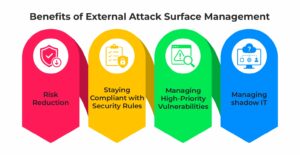
Risk reduction: Security teams often discover vulnerabilities only after attacks occur. EASM allows us to address this security issue by effectively monitoring and identifying unknown assets and misconfigurations. Faster detection lessens the attack window and hinders cybercriminals' opportunities to exploit vulnerabilities.
Managing shadow IT: EASM enables security teams to find and manage hidden or unmanaged assets that belong to the organization. It generally improves visibility to systems, even those not listed in the official asset list, helping organizations improve their overall cybersecurity and reduce risks from shadow IT.
Managing High-Priority Vulnerabilities: Vulnerabilities do not carry equal levels of security risk. Some vulnerabilities are quite simple for attackers to exploit, causing damage to organizations' systems. EASM tools assist the security team in identifying risks that require immediate attention. They also help in auditing asset exposure, business importance, and attack likelihood.
Staying Compliant with Security Rules: EASM tools and products help organizations stay compliant with security rules and regulations. These tools can scan external systems and identify compliance gaps where the company is not following required security standards. Organizations often identify compliance gaps in cloud systems or external-facing assets across multiple regions.
Final Thoughts:
Attack surfaces are growing quickly due to a significant shift toward cloud adoption, remote work, APIs, and connected digital services. EASM products help organizations overcome security challenges before attackers can exploit them. Alongside, it strengthens security operations, thereby reducing the risk of external attacks.
Want to learn and explore more content related to cybersecurity. Please visit our official website.
FAQs
Q1. What is the difference between internal and external attack surfaces?
Answer: External attack surfaces are assets that are exposed to the internet that cyber attackers can access from outside an organization.
Internal attack surfaces are assets operating within the organization's network. These assets include internal applications, employee devices, the database, shared drives, and internal servers.
Q2. What are examples of an external attack?
Answer: External attack examples include
-
- Phishing attacks
- DDoS (Distributed Denial-of-Service) attacks
- Exploiting exposed cloud storage
- Attacking open ports or remote desktop services
Q3. What are the types of external attack surfaces?
Answer: External attack surfaces are classified into the following types:
-
- Web applications
- APIs (application programming interface)
- Cloud services and infrastructure
- Domains and subdomains
- Remote access services
Recommended For You:
What Is a ClickFix Attack? How Paste & Click Is Being Used to Hack Users