The cybersecurity landscape is evolving every single day. With the rise in cyberattacks, organizations have become the primary target. Attackers are constantly trying to exploit sensitive data to gain financial benefits, disrupt operations, and damage business reputations. According to reports, the global cybersecurity market size was valued at $271.9B in 2025 and is projected to grow from $302.0B in 2026 to $663.1B by 2033.
Thus, it is essential to have the right cybersecurity set up in place to protect against cyber threats. With the many options, you can choose between managed security services (MSS) or have your own in-house cybersecurity team to look after your organization’s security operations. Both approaches offer certain benefits and work well to strengthen an organization’s security posture, but they vary in several aspects.
This blog is curated to help you understand everything about managed security services and in-house cybersecurity, including their benefits, differences, and which model works best for your business. So, let’s get started.
What are Managed Security Services?
Managed security services are cybersecurity services provided by a third-party firm known as a managed security service provider (MSSP). In this model, the provider manages the security operations for you, allowing your team to spend more time on the strategic aspects that matter the most for your business.
This mainly includes continuous monitoring of your IT environment, threat detection, incident response, and basic measures such as multi-factor authentication and patching, all for a monthly subscription fee instead of hiring a full security team.
MSSPs act as an extension of your security team, keeping a close eye on your IT infrastructure. They are becoming important as organizations face resource challenges and cybersecurity-related risks.
Strategic Benefits of Adopting Managed Security Services (MSS)
- 24/7 Threat monitoring and response: MSS provides continuous visibility into the IT network and systems. This ensures that threats, suspicious activities, or potential breaches are detected faster, that measures are implemented accordingly, and that the impact of attacks is reduced.
- In-depth knowledge: Partnering with an MSSP provider gives your organization a team of skilled security professionals. Thus, it reduces costs by hiring a separate in-house team to perform critical tasks.
- Compliance assistance: Managed security services help organizations meet compliance and regulatory requirements. They assist with all the documentation for GDPR and PCI DSS, prepare for audits, and more.
- Focus on main business goals: Organizations can focus on growth, innovation, and customer satisfaction by outsourcing everyday security operations.
Cost of Managed Security Services
The cost of MSS depends on several factors including the company's size, the required services, and the providers' technology stack. Most managed security service providers today rely on AI and automation for basic tasks rather than hiring large cybersecurity teams, thereby reducing the cost of building an in-house cybersecurity team.
The services organizations typically depend on predictable subscription models rather than on investments in infrastructure and staff. Basic services such as firewalls and antivirus are affordable, whereas high-end options like zero trust architectures cost more but enable faster threat detection. Organizations can scale out services as their requirements grow.
What is In-House Cybersecurity?
It is basically an in-house team of cybersecurity professionals that monitors and manages an organization's security posture. Embedded within the organization, it offers direct oversight of security strategies, making it ideal for complex IT environments or handling sensitive information. Building an in-house SOC team is a significant job that involves hiring a dedicated team, deploying high-end technologies, and integrating security operations within the company’s ecosystem.
The internal team manages the following aspects of an organization:
- Incident response
- Network security
- Endpoint protection
- Compliance management
- Risk assessments
- Security tool administration
Benefits of Having an In-House SOC
Even though in-house cybersecurity requires upfront investment, it offers notable benefits that organizations must consider.
- Complete Control and Customization: In-house operations provide complete control over security tools and strategies, allowing customized solutions that align with organizations' goals.
- Compliance management: Attain and monitor compliance with industry and regulatory standards such as ISO 27001, PCI DSS (Payment Card Industry Data Security Standard), HIPAA, GDPR, or NIST, making audits and reporting more efficient.
- Improved Collaboration: An internal SOC works closely with DevOps, legal, compliance, and IT teams. This collaboration helps improve communication, streamline incident management, and support faster implementation of security practices.
- Enhanced Data Privacy: All the sensitive information, including the data logs and incident information, remains within the organization, reducing dependence on third-party providers.
In-House Security Cost Considerations
Building and maintaining an in-house SOC team is a major investment. Hiring experienced staff often comes with a large salary range that becomes difficult for organizations to bear. There are other key cost drivers, which include:
- Salaries & Benefits: Cybersecurity professionals like SOC Analyst L1/L2 earn $75,000+ per year, with Incident Responder earning $110,000+ per year, and Security Engineer/Senior Analyst earning $100,000 per year. 24/7 monitoring requires staff to work all three shifts, which adds to their salaries.
- Infrastructure: Investments in hardware, software licensing, regular upgrades, and the tools, make the overall cost more.
- Training: Staff require continuous training and upskilling to keep pace with the evolving threat landscape, which costs both time and money.
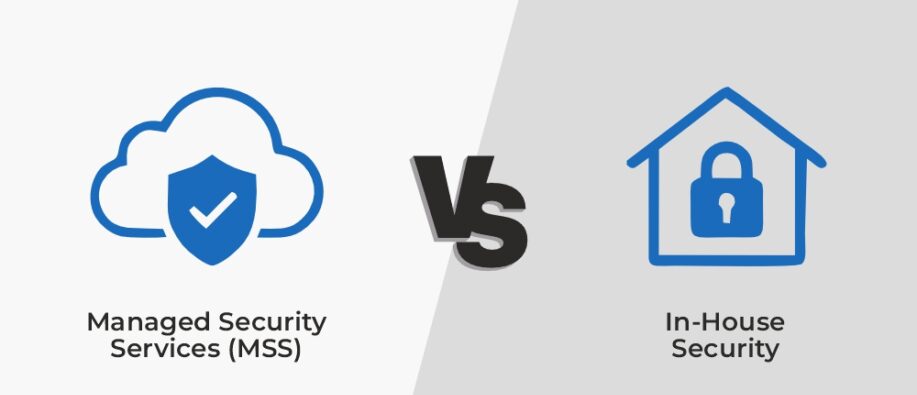
Managed Security Services vs In-House Cybersecurity: Key Differences to Know
Let’s compare MSS and in-house cybersecurity in different aspects.
Feature |
MSS/Managed SOC |
In-House Cybersecurity |
| Function | A third-party provider manages the organization's security operations. | An internal team manages the security operations within the organization. |
| Coverage & Response | 24/7 monitoring, faster threat detection, incident response, and more. | Due to staffing constraints, 24/7 coverage is expensive. |
| Cost | Lower upfront investment, with predictable monthly or annual subscription fees. | Higher costs due to hiring, training, salaries, infrastructure, and security tools. |
| Customization | Subscription plans can be scaled according to the client's needs. | Standardized services require scaling, which requires hiring and additional infrastructure investment. |
| Control | Less control over the security operations, even though the policies remain within the organization. | Full control over the security strategies within the organization. |
What Does It Look Like to Take a Hybrid Approach?
You don’t have to choose between an MSS and an in-house cybersecurity team. A hybrid model works the best. Your in-house team manages all the security settings, compliance frameworks, policies, and strategies. On the other side, the managed security service provider handles 24/7 monitoring, threat detection, and an incident response plan. This approach is becoming popular as companies boost their security without doing everything on their side or giving full control.
- How does the model work in practice?
- Shared responsibilities between the internal security team and MSSP.
- You can decide what an MSSP can do and what requires your approval.
Those are all good reasons for decision-makers to consider a middle road.
Which Model Should You Choose? MSS or In-House Cybersecurity?
Choose managed security services if your organization:
- Has limited resources for cybersecurity aspects or budget.
- Requires 24/7 monitoring with no requirement for a Security Operations Center (SOC) to be built.
- Wants access to the latest security technologies.
- As a business grows, it needs scalable security services.
Choose In-House Cybersecurity if your organization:
- Has strict control over security operations and sensitive data.
- Works in highly regulated industries that have complex compliance requirements.
- Has a budget for a dedicated cybersecurity team.
- Requires highly tailored security policies and workflows.
Final Words!
Choosing between managed security services and in-house cybersecurity is not just about determining which model is better; it is about which solution best aligns with your organization’s security requirements and long-term goals.
It requires a nuanced understanding of each model’s strengths, limitations, and more. Managed security services provide cost-effective access to expert security teams, 24/7 monitoring, and advanced tools, while in-house teams offer greater control and customized security strategies. After all, in the end the choice is all yours! Pick the best model for the security operations of your organization and rest easy knowing your business is protected.
For more such cybersecurity-related blog posts, don’t miss out on visiting our website.
FAQs
1] What is the difference between MSP and SOC?
Answer: MSPs handle the general IT services of the company, including infrastructure, whereas SOC focuses on overall cybersecurity monitoring.
2] Does an MSSP replace my IT team?
Answer: No, an MSSP complements your in-house IT team rather than replacing it. Your internal team handles day-to-day operations, while an MSSP fills the gaps with 24/7 monitoring, threat detection, incident response, and more.
Recommended For You:
7 Best Cybersecurity Tools to Protect Your Organization’s Data