
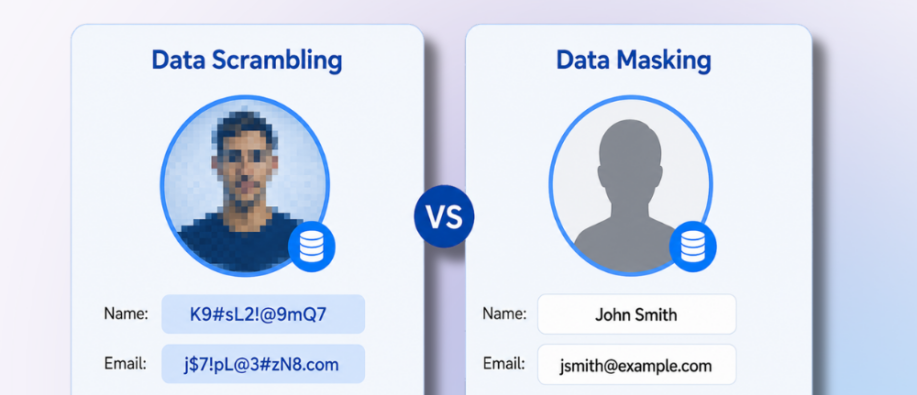
Data is one of the most valuable assets of any organization. It is used to develop applications, test software, generate business insights, and even train AI models. Using real customer information in these environments can expose sensitive customer data and significantly increase serious data privacy risks.
As reported by IBM's 2025 Cost of a Data Breach Report, the global average value of a data breach reached USD 4.44 million. This highlights that failing to protect sensitive data can lead to major financial losses. To reduce security risks while preserving data utility, organizations must decide between data scrambling and masking.
While both techniques' primary aim is to hide sensitive values, they differ fundamentally in execution, data realism, and regulatory compliance.
Choosing the wrong technique can compromise testing environments, reduce data accuracy, and create compliance risks under data protection laws like GDPR and HIPAA.
Therefore, organizations need to understand data scrambling vs data masking when handling Personally Identifiable Information (PII), financial records, healthcare data, and other sensitive business information while complying with data privacy regulations.
In this blog, we'll compare data scrambling and data masking, analyze their pros and cons, and provide real-world use cases to help you choose the best strategy for your operational requirements.
Data Scrambling vs Data Masking: A Detailed Comparison
Before exploring each technique in detail, here is a quick comparison of data scrambling vs data masking to help you understand their core differences.
Comparison Criteria |
Data Masking |
Data Scrambling |
| Primary Objective | Protects sensitive data by replacing original values with realistic but fictitious data. | Protects sensitive information by rearranging, randomizing, or modifying original data values. |
| Data Format | Preserves original format and structure, ensuring applications continue to function as expected. | May preserve or alter the original format depending on the scrambling technique. |
| Data Usability | Maintains realistic datasets for software testing, analytics, development, and training. | Suitable for scenarios where realistic data is not a priority. |
| Data Integrity | Preserves business logic and relationships between related datasets. | May affect data relationships and consistency if not implemented carefully. |
| Regulatory Compliance | Commonly used to support compliance with GDPR, HIPAA, PCI DSS, and similar regulations. | Can reduce data exposure but may require additional security controls to meet compliance requirements. |
| Implementation Approach | Applies predefined masking rules based on data sensitivity and business requirements. | Uses scrambling algorithms to alter original values without exposing sensitive information. |
| Ideal Use Cases | Development, QA testing, cloud migration, analytics, employee training, and secure third-party data sharing. | Internal testing, temporary datasets, demonstrations, and low-risk non-production environments. |
| Key Consideration | Requires careful planning to maintain data quality and consistency across systems. | Faster to implement but may reduce the usefulness of data for complex business processes. |
Now that we have seen the key differences, let’s explore how each technique works, where it is used, and when it's the better choice.
Data Masking: Preserving Data Utility Without Exposing Sensitive Information
To fully understand data scrambling vs data masking, you must first understand how data masking works.
Organizations need realistic customer data for software testing and development without exposing actual personal information. Data masking addresses this challenge by replacing sensitive values with realistic alternatives while preserving the dataset's structure and usability.
The importance of protecting sensitive information continues to grow. Verizon’s 2025 Data Breach Investigations Report (DBIR) accounted for 22% of confirmed data breaches involved credential abuse.
Why Engineers and Security Teams Use Data Masking
Protects production data in testing environments: If a testing server is hacked, attackers will only find masked information instead of real customer data.
Keeps the data useful for building software and testing: Developers and QA teams need realistic databases for software testing and test data management. Before sharing the original production database, it is masked to preserve important formats and relationships while avoiding exposure of actual customer identities.
Simplifies legal and privacy compliance: Supports compliance with GDPR, HIPAA, PCI DSS, and other data privacy regulations by protecting sensitive data before it is shared.
Allows safe third-party outsourcing: You can safely share information with external contractors without risk of data leaks.
Data Field |
Original Value |
Masked Value |
Masking Technique Used |
| Customer Name | Michael Johnson | M****** J****** | Character masking |
| Email Address | [email protected] | M******@email.com | Partial masking |
| Credit Card Number | 5425 1234 9012 1122 | XXXX XXXX XXXX 1122 | Redaction/Truncation |
| Social Security Number | 123-45-6798 | 845-65-4321 | Data substitution |
This workflow allows effortless integration testing without sharing actual customer databases.
Different Types of Data Masking
- Static Data Masking (SDM):Static data masking permanently replaces sensitive fields in a copied database. The original database remains protected, and teams work with the masked version.
- Dynamic Data Masking (DDM):Dynamic data masking applies masking rules in real time when users access data. It only displays protected values based on user roles, keeping the original database unchanged.
Data Scrambling: Obfuscating Sensitive Data Through Transformation
Data scrambling is a data protection technique that maintains data confidentiality by transforming sensitive information into an unreadable format. To make the original data difficult to interpret, it alters sensitive data by rearranging, replacing, or transforming values into a scrambled form. Data scrambling does not intend to maintain a realistic representation for business use.
Techniques used in data scrambling:
In data scrambling, the database is automatically modified using the following data scrambling techniques:
Character Scrambling: Rearranges characters within a value to make original information difficult to understand.
Example: John Smith --------> oJnH tmhSi
Value Shuffling: Shuffles values within records in the same column without changing the overall dataset structure.
Randomization: Replaces original values with randomly generated data that has no relationship to the source of information. It cannot represent actual customer behavior.
Permutation: Changes the order of characters, numbers, or records according to a predefined pattern, making the primary data difficult to reconstruct.
How Data Scrambling Protects Sensitive Information
Quick and simple to implement: It protects valuable data with minimal setup and fewer configuration rules than advanced data masking techniques. Since it does not preserve realistic data formats or business logic, it can be implemented quickly for internal and temporary use.
Useful for low-risk environments: Data scrambling is beneficial when the primary goal is to hide sensitive data rather than maintain a production-like dataset. It is usually suitable in environments like internal demonstrations, temporary testing, and basic data sharing.
Helps reduce accidental data exposure: Before datasets are copied or shared, it reduces the chances of exposing readable information to unauthorized users.
Although both techniques are designed to protect sensitive information, they differ significantly in how they preserve data usability, maintain business logic, and support regulatory compliance. The comparison below highlights the core differences between data scrambling vs data masking, helping businesses choose the most suitable approach for their security and operational needs.
How to Choose Between Data Scrambling and Data Masking
Choosing between data scrambling vs data masking helps organizations balance security, compliance, and data governance requirements while protecting raw data. The right approach helps organizations protect sensitive information while ensuring that data remains suitable for day-to-day business operations such as testing and analytics.
The wrong choice can affect application performance, data accuracy, regulatory compliance, and even increase the risk of data exposure. For many organizations, the right choice is not either-or. Different environments require different protection techniques depending on business objectives.
Thoroughly understanding how these techniques differ will help the security team select the most appropriate and effective data protection technique.
Data Scrambling vs Data Masking: Misconceptions
One very common misconception amongst organizations is that data masking and data scrambling are just two separate methods in the security landscape, and that organizations must choose between the two. But in reality, each method serves a different purpose.
Misconception 1: Masked or scrambled dataset is always safe to use
Protecting data is important, but preserving its usability is equally critical for testing and analytics.
Misconception 2: Data scrambling and data masking deliver the same results
While both protect sensitive information, they are designed for different business and security requirements.
Misconception 3: One solution fits every environment.
The right choice depends on your organization's compliance obligations and how the data will be used.
Conclusion
There is no one-size-fits-all solution to protect sensitive information. The right choice between data masking vs data scrambling relies heavily on your organization's security, compliance, and operational requirements. For organizations that require a realistic database for software testing, development, or analytics, data masking is considered the best choice. Data scrambling is better suited for internal or temporary use where quick data protection is more important than preserving realistic data. Analyzing how your data will be used will help you select the most useful technique to protect data without compromising business needs.
For more such information related to security and advanced data protection please visit our official website.
FAQs
1. Can data scrambling be reversed?
Answer: It depends on the scrambling techniques used. Some methods, such as value shuffling or character scrambling, can be reversed if the original mapping or algorithm is preserved. However, most organizations use irreversible scrambling techniques to minimize the risk of data exposure.
2. Which are the top data masking tools?
Answer: Below are some of the best data masking tools used by organizations to protect sensitive information:
K2View Data Masking, DATPROF – Test Data Simplified, IRI FieldShield, IRI DarkShield, Oracle Data Masking and Subsetting, Delphix.
3. Are data masking and anonymization the same?
Answer: No. Data masking preserves data usability by replacing sensitive values, while data anonymization permanently removes identifying information to prevent re-identification.
Recommended For You:
Data Security and Predictions: 2025 and Beyond
Data Privacy vs. Data Security: Why It Matters for Internal Auditors?