

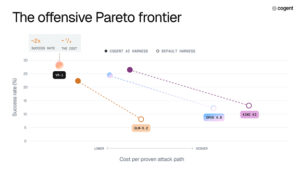
In benchmark testing, VR-1 proved twice as many enterprise attack paths as leading frontier models, at roughly a quarter of the cost.
SAN FRANCISCO, July 27, 2026 /PRNewswire/ -- Cogent Security today introduced Cogent VR-1, a frontier reasoning model built for cybersecurity and trained to operate inside live enterprise environments. On IntrusionBench, a new benchmark for real-world enterprise attack chains released alongside the model, VR-1 began with a single foothold and autonomously proved viable paths to its objectives, achieving 2x the performance of other frontier models.
IntrusionBench results, which measure VR-1 against Kimi K3, Opus 4.8, and GLM-5.2
Most frontier models can find a single bug in a single codebase. Real attacks rarely stay that contained. They travel through a chain of small, individually unremarkable weaknesses. A public service exposes a minor flaw. An identity carries more permission than it needs. Somewhere in the build pipeline, an artifact gets trusted without ever being checked. On their own, each looks like ordinary backlog noise. Strung together, they become a path to a crown jewel.
Cogent trained VR-1 to work the way a skilled adversary does. Given a foothold inside an enterprise, it maps the surrounding environment and connects weaknesses that span different systems to prove which paths are actually reachable. It then checks whether a proposed fix closes the gap or simply relocates the risk. Reasoning that once took an expert security researcher weeks runs in hours.
The release lands as autonomous AI attacks stop being theoretical. In recent months, fully autonomous AI attacks have targeted some of the world's largest governments and technology companies. Defenders need matched AI capabilities at this level to understand where AI-driven attacks could succeed at breaching their environments so they can harden their environments against AI-driven attacks.
"For two years, every security vendor has claimed to be AI-native. VR-1 lets us put a number on it," said Vineet Edupuganti, CEO of Cogent Security. "This is Mythos-level security reasoning, running inside a customer's actual environment. We can show them exactly which attack paths a frontier-capable adversary could reach, then use the same model to close them. Attackers already have this capability. Our job is to make sure defenders get it first, and that it runs under real controls."
Composition Is Where Existing Frontier Models Fall Short
Existing benchmarks measure whether a model can exploit code in isolation. IntrusionBench measures something closer to a real breach. The test starts with an agent that has a foothold and an objective, then scores whether it can chain its way across cloud infrastructure, identity systems, and a company's own internal tools to reach a specific target and prove it got there. Runs are graded by execution rather than by what the agent claims it could reach.
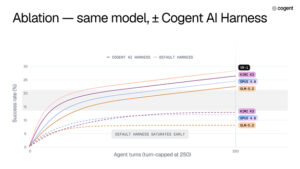
The benchmark is Cogent's own work. The figures above come from the hardest configuration, where the agent is told nothing about the environment it lands in. As more of that environment was revealed, every model improved and the spread narrowed. Once the source code and the underlying weakness were disclosed outright, the models converged, which suggests VR-1's advantage comes from investigating ambiguity rather than from raw exploitation skill.
"The frontier models security teams use today can find an attack path, but only as a byproduct of being good at code and reasoning. No one set out to build a model for this, so we did," said Geng Sng, co-founder and CTO of Cogent Security. "VR-1 is trained specifically for the multi-step attacks that play out in real, messy enterprise environments. That focus is what moves it past the general-purpose frontier models on the problems defenders actually face."
The Runtime Matters as Much as the Model
Alongside VR-1, Cogent is releasing the Cogent AI Harness, the runtime that makes a model like this safe to deploy inside a live enterprise. It gives any capable model, open-weight or frontier, the environment context, scoped tools, policy enforcement, and verification needed to operate as a governed security agent. Every action is checked against the customer's own policy and backed by evidence. Cogent's principle for validation is "prove, don't detonate": exposure gets confirmed without causing damage, persistence, or disruption.
Access Limited by Design
VR-1 is not being released openly. Because the capabilities that help defenders can also be misused, Cogent is making the model available only to vetted organizations through the Cogent Frontier Access Program, with the company's safety guardrails, policy controls, and audit logging in place. Participants work directly with Cogent Research on model evaluation, validation in their own environment, and safe deployment.
Qualified participants can also receive a Frontier Model Risk Assessment, a grounded readout of the attack paths a frontier-level model could reach inside their environment, which weaknesses become more dangerous as AI capabilities advance, and where AI can be deployed safely to reduce that risk.
Organizations can apply at cogent.com/frontier.
About Cogent Security
Cogent is an applied AI lab whose agents detect and fix security vulnerabilities faster than attackers can exploit them. The Cogent platform identifies exposure to new vulnerabilities within minutes, builds contextualized remediation plans, and executes fixes at whatever level of autonomy the customer allows, from human-approved to fully autonomous. Fortune 500 security teams using Cogent have reduced the exposure window for critical vulnerabilities by 97 percent. Built by researchers and operators from Google DeepMind, Abnormal Security, and Coinbase, Cogent is backed by Greylock Partners and Bain Capital Ventures. Learn more at cogent.com.
SOURCE Cogent Security
Also Read:
Managed Security Services (MSS) vs. In-House Cybersecurity: Which Model Suits Your Business