

Digital content has become one of the primary ways people access information. Billions of videos, images, and social media posts are created and shared every day on digital platforms. At the same time, multiple AI-powered tools allow the creation of digital content. While these technologies offer many benefits, they can also be misused to create misleading or fabricated content. As a result, we are unable to distinguish between original and fabricated information, making it difficult to maintain digital trust and information integrity.
To address these challenges, we use content provenance. It is an effective approach to promote digital trust and preserve information integrity. A recent market study shows that the demand for content provenance and synthetic media verification services is expected to reach USD 24.0 billion by 2036.
In this blog, we will examine in detail what content provenance technologies are, along with which technologies are working behind it and its benefits.
What are Content Provenance Technologies?
Content provenance enables tracing the origin of content, including the identity of its creator and the tools used. It also helps verify its timestamp and edit history. Therefore, these technologies play a vital role in providing users and organizations with higher transparency and authenticity related to digital content.
Content provenance technologies are a set of tools specially designed to maintain content provenance. Their primary focus is to obtain and preserve provenance information throughout the content lifecycle.
They help in monitoring:
- Content creator information: Identifies the original creator of the content.
- Creation date and time: Records the time at which the content was created, along with the date.
- Edit history: Tracks all modifications that were made to the content, including any filters or AI enhancements applied.
- Sources or origin of the content: Shows where the content was stored, generated, or transferred.
- How the content is created: shows which tools and software were used.
This information is recorded to build digital trust, reduce misleading and malicious activities, and authenticate digital interactions.
How Content Provenance Technologies Work
Content provenance is a continuous, streamlined process that starts as soon as digital content is created.
- A provenance record is automatically attached to the content at its source.
- Once the content creation is complete, it is shared across platforms and the record remains attached.
- It allows users or organizations to verify metadata and history whenever required.
Technologies Behind Content Provenance
Content provenance is supported by numerous technologies that help ensure the authenticity, integrity, and credibility of digital content. One of the best-known projects is the Coalition for Content Provenance and Authenticity (C2PA). It is an open technical standard that defines and verifies how content credentials are attached to digital content, enabling verification across platforms.
Digital signatures and cryptographic identity are important elements of digital content security. They help confirm the identity of a system or user, ensuring that digital content is protected from tampering.
Other technologies that help protect digital content credentials include cryptographic hashing and digital watermarking which support verification and authentication. Digital watermarks help identify ownership and trace content source. Cryptographic hashing preserves file integrity by detecting any unauthorized changes.
Why Content Provenance Technologies Matter in the Digital World
The proliferation of digital content has made it very difficult for users to distinguish between real and fake information and determine what can be trusted. The rise in content generation, especially with the help of AI, has escalated. Hence, the spread of misleading and fabricated information across platforms has also surged. It has also become a channel for interference and malicious cyber activities.
As a result, it is crucial that digital content be authenticated and its integrity be maintained.
Content provenance technologies provide an effective way to verify digital content. It helps pinpoint the original creator of a piece of content. Users can check whether the shared digital content has been modified or is in its original state. This transparency helps build user trust and strengthens the authenticity and reliability of the content.
Benefits of Content Provenance Technologies
Content Provenance Technologies offer several benefits that create, share, or consume digital content. By improving content transparency, a more trustworthy environment can be built.
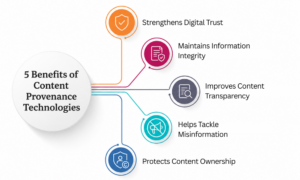
- Strengthens digital trust: Enables users to verify the origin and authenticity of digital content, further helping in making informed decisions about the information an individual consumes.
- Maintains information integrity: By detecting unauthorized modifications and ensuring that content remains authentic throughout the content lifecycle, maintaining integrity of digital content becomes easy.
- Improves content transparency: By keeping a record of details such as creator, creation date, and edit history, greater transparency is provided about how the digital content was produced and modified.
- Helps tackle misinformation: It becomes easier to identify manipulated or misleading content with the help of provenance technologies.
- Protects content ownership: With the help of these technologies, linking content to its original creator and maintaining content credentials help reduce unauthorized use.
Applications of Content Provenance Technologies
Journalism and news media: Verify whether news reports, images, or videos are fabricated before they are published on official platforms or channels.
Social media platforms: Help users identify authentic content and its origin, preventing the spread of misleading content.
Digital photography: Helps photographers and digital artists establish authenticity and ownership of their work.
Healthcare and research: Assists in maintaining the integrity of critical information by verifying the origin of medical records, research data, and scientific publications.
Final Verdict
The demand for digital content will continue to grow. As a result, AI-generated content is becoming more common. It is essential to verify the authenticity and integrity of content distributed on platforms. For this purpose, content provenance technologies provide a reliable method. It helps verify digital content, improve transparency, and strengthen digital trust. Ultimately, it also helps build a more transparent, trustworthy, and secure digital ecosystem.
For more insights, please visit our official website.
FAQs
Q1. What role does C2PA play in content provenance?
Answer: C2PA stands for Coalition for Content Provenance and Authenticity. It is an open technical standard specifically designed to verify the records of content, including its origin and its entire history.
Q2. What are content credentials?
Answer: Content credentials are tamper-evident metadata appended to digital media that provide information regarding its origin, creator, modifications, and authenticity.
Q3. Do content provenance technologies help combat deepfakes?
Answer: Yes, content provenance technologies can help combat deepfakes by allowing users to validate the source and history of digital media. They cannot prevent deepfakes from being created. They make it easier to identify authentic content, thereby reducing the spread of misleading or manipulated media.
Related Reads:
Online Privacy: What Is It and Why Is It Important?
Data Privacy Laws: Key Information You Need to Know About Protection and Compliance