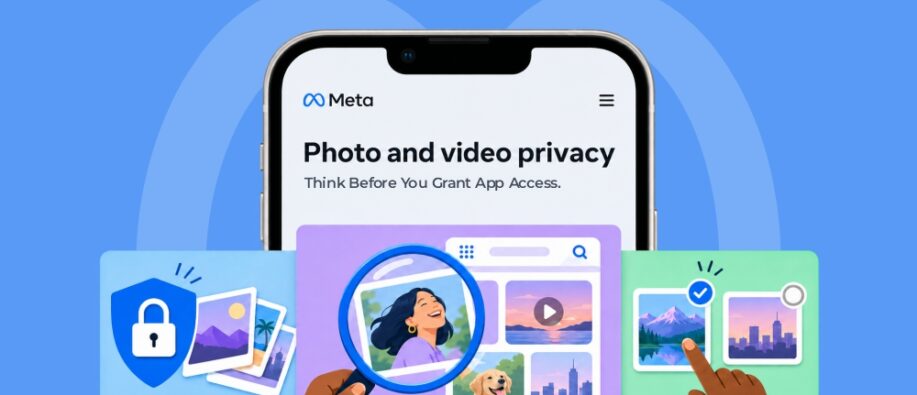
We usually have several social media accounts on different apps. Facebook, Instagram, WhatsApp, and Telegram are some of them. When you open or access any social media app on your phone, you may think the photos or videos on your phone are safe unless you choose to share them across these apps. According to Statista reports, around 75% of mobile apps want access to user data.
However, a recent concern about Meta’s Facebook app in Italy was brought to light on November 14, 2026. Italy’s data protection authority (the Garante) has fined Meta €887 million for accessing photos, videos, and metadata from Android users' phone galleries without obtaining their consent. In this blog, we will walk through the recent Meta privacy concerns, alongside the steps you can take to protect your photos and videos.
How Did Facebook Got Access to Users’ Photo Galleries?
The concern highlights a feature called "Get camera roll suggestions when you're browsing Facebook," introduced in 2023, giving rise to Meta privacy concerns. The feature aims to make posting easier by suggesting photos and videos on users' phones while they browse Facebook. Users truly relied on this feature; however, investigators have found that the app requested access to the phone's photo gallery.
The Garante has warned that this permission could let Facebook access an Android device's entire photo library, including photos, videos, and metadata, without users knowing what information was accessed.
A similar issue can take place with contact access. A messaging app can request access to the address book to suggest friends or enable contact discovery. Users may not be aware of all these when granting access. So, this Meta privacy concern is about the platform accessing your gallery, which might contain sensitive data you don't want to expose.
Regarding the Privacy Penalty in Italy
Italy’s data protection authority has fined Facebook’s parent company, Meta, $887 million for accessing users’ photos without their specific consent. According to the investigation, Meta accessed photos, videos, and metadata belonging to Italian users through the Facebook app on Android devices.
Another point is that Italian regulators have given Meta 60 days to turn off the feature by default and require separate explicit consent going forward. They also require Meta to signpost what the consent request is for, so users know it involves photo gallery access, and to explain how to disable it.
Meta should report the steps it has taken toward compliance within 30 days and measure its progress within 90 days. If the company fails to do so, it will be banned from enabling the feature for Italian Android users who don't provide valid consent.
The Meta Privacy Concern: Impact is Real
The table below clarifies the details of Meta's recent privacy concerns. Take a look:
| Parameter | Details |
| Company | Meta |
| Product | Facebook app on Android |
| Fine | $805 million ($887 million) |
| Regulator | Italy's data protection agency |
| Data | Photos and videos |
| Investigation Started | 2025 |
Italy's regulator has given two remedies. First, Meta should turn off the feature by default. Second, the company should obtain separate user consent within 60 days. Both of these conditions are important.
| Deadline | Requirement |
| Within 30 Days | Share the steps taken towards compliance |
| Within 60 Days | Turn the feature off by default and get a user consent |
| Within 90 Days | Share a progress report |
Why is Meta's Photos and Video Access Raising Privacy Concerns?
As we know, AI and auto-suggested content are becoming common; personal media access is one of the key challenges.
Not all pictures on your cell phone are shared. A device gallery is filled with photos, important documents, screenshots, and other sensitive data. Facebook apps having access to your personal photos is indeed a concern. The concern is even more serious if applications add functionality that reads camera data to provide customized recommendations.
Use of AI in training and personal settings: Meta uses information from its products and services to improve its AI systems. Thus, photos and text from Facebook and Instagram have been used to train generative AI models. Meta AI also analyzes interactions, such as messages, to enhance its AI capabilities.
Some of the Key Risks Include:
- Data exposure: If personal media is compromised, private photos or videos can be accessed by unauthorized individuals.
- Unintentional sharing: Incorrect privacy settings or uploads may expose your content to a wider audience than you intend.
How Do Smartphone Permissions Work?
Android and iOS let users control which device features apps can access, including contacts, photos, the camera, and location. The level of access you grant depends on the permission requested, the operating system version, and the options available to users.
Carefully review the app's permissions before granting access. These controls determine what an app can access on the device. They do not provide details about what information is used after collection, or which third-party services can receive.
What Can Facebook Users Do to Stop an Android Phone from Accessing Photos and Videos?
Facebook users can follow the settings below to change permissions:
- On an Android phone, go to Settings
- Go to Apps and Select Facebook
- Tap Permissions and then select Photos and Videos
- Then select Don’t allow gallery access.
Depending on your Android version and the app, you may also be able to allow access only to selected photos and videos.
- Open Facebook and review any camera roll suggestions or photo sharing settings. Also disable features you don’t use. Menu names can vary by device.
Users should also carefully review permissions granted to other social media apps, especially when they have access to the camera, contacts, and location.
Market Impact for Meta Privacy Concerns and the Entire App Ecosystem
For Meta, this stands as a direct financial loss and a warning for other app developers. Thus, companies like Meta should carefully review their privacy settings and maintain the accuracy of their social media ecosystem. Now, regarding the app ecosystem, a startup with a camera roll feature should get the flow right before getting penalized later. Platform owners could also have questions. Regulators could also be interested in the types of permissions apps request and the process for managing phone permission settings.
Wrapping It Up on Meta Privacy Concerns!
Personal photos and videos are digital files that capture moments. They become memories you can watch later and share across social media. As Meta and other tech companies introduce new AI-powered features, users should be more aware of how apps access and process their personal media.
You mustn't grant apps access randomly. Alongside this, companies should follow best practices to keep users’ data safe and secure. We hope you clearly understand the context of Meta's privacy concerns and the practices you can follow. Capture moments but keep it safe.
Read more cybersecurity-related blogs on our website.
FAQs
1] How can I stop Facebook or Instagram from accessing my photos?
Answer: You can manage or change the photo permissions through your phone's privacy settings. You can also choose limited photo access where supported.
2] Is Meta on Facebook safe?
Answer: Using Meta or Meta AI on Facebook is safe from malware and account theft if you follow basic security practices, though privacy and scam risks remain.
3] Is it safe to share photographs on social media?
Answer: Yes, but be mindful of privacy risks, especially when images contain sensitive information or location metadata.
Also Read:
What Is Meta Muse App? How the World’s First Personal AI Agent Works
What to Do If You Get Scammed on Facebook, Messenger, & WhatsApp – New AI Protection Tools Explained