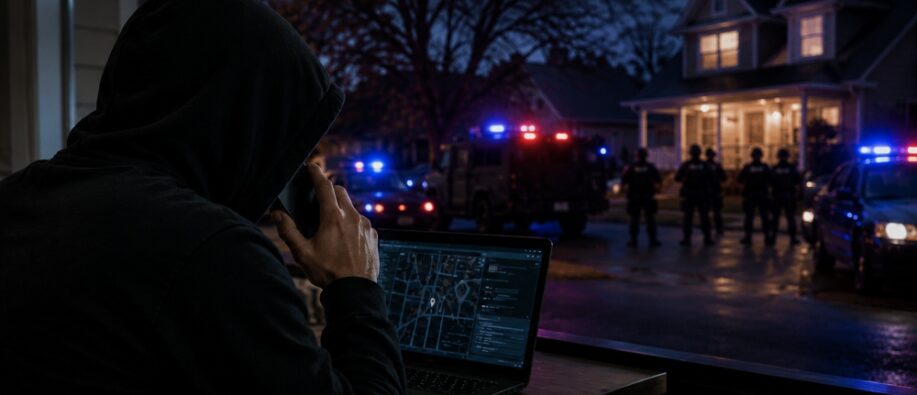
Let us assume you are playing an online game and streaming it live. In the middle of the game, you get into a disagreement with another player. To provoke you or take revenge, that person obtains your identity and address. Then they make the report appear credible and make a false emergency report to the authorities. Falsely claiming that a major cybercrime is being conducted at your address.
Emergency responders immediately investigate the details, believing it to be true to their knowledge. But after arriving, they realize there was no emergency. This act of generating false emergency reports to provoke a police or emergency response and create chaos against a target victim is known as swatting.
We will delve deeper into what swatting involves, the methods attackers use to gather essential information, and, crucially, how you can protect yourself against it.
Defining Swatting for Cybersecurity
Swatting is the act of falsely reporting a call for help to emergency services. It is a cyber-enabled harassment tactic to fool emergency services into sending a SWAT team to the scene.
Special Weapons and Tactics (SWAT) teams are specially trained to handle high-risk events and emergencies. Incidents of making false emergency calls have become more frequent among cybercriminals. It is a dangerous practice of harassment intended to take revenge, which is prominently experienced during livestreaming and in online gaming communities.
How Swatters Make False Emergency Calls?
By fabricating life-threatening situations, swatters exploit emergency response systems and divert law enforcement resources.
According to the U.S. Department of Homeland Security, the Federal Bureau of Investigation (FBI), and the National Counterterrorism Center, more than 100 distinct swatting-related threats were documented in 2024, affecting over 1,000 institutions across 42 states within a month.
Target Selection
Swatters do not usually prank any random individual and call emergency authorities. They choose a specific individual, often after an online dispute or gaming disagreement, or as an act of harassment, or with the intention of ruining someone's reputation.
Collecting information through doxing
Doxing is a tactic used by swatters to collect victims' personal information. Attackers illegally collect sensitive data from various online applications and websites, as well as through data breaches.
Information such as usernames, contact numbers, and addresses, is then documented in a detailed profile of the target. This gathered information helps the attacker to make the emergency report sound believable.
How attackers trick emergency calls
Swatters connect with emergency service systems using a script that simulates an emergency at the victim's location. Some swatters use an AI-generated voice to impersonate someone familiar, fake a phone number, or employ other tactics to make the report appear more credible.
Once law authorities and the SWAT team believe the situation or false report is real, they take immediate action, which can lead to many serious consequences.
Consequences of Swatting
Many swatters think that making a false emergency call is just a prank and will not have any long-term effects on the victim. However, the reality hits differently: a fake emergency call can lead to serious consequences, including misuse of emergency services and severe trauma to the victim. Although the attack begins online, it produces offline consequences.
Impact on emergency services
When a false report is made, emergency response teams, including SWAT units, are dispatched to an incident that has never occurred. These valuable resources could have been used for genuine emergencies. Such misuse of emergency services worsens the situation by diverting their attention from real threats. Repeated false reports can place additional pressure on emergency response authorities.
Impact on victims
When authorities unexpectedly arrive at the victim's location, the individual may experience fear, confusion, and distress because they are unaware of the false report. The incident can leave a lasting emotional impact on them. Some individuals may feel unsafe even after the circumstances are resolved. Most significantly, their personal and professional reputations may also be negatively affected.
Public safety risks
Swatters not only disturb emergency services and harm victims but also pose a broader public safety risk. False reports may create unnecessary fear within the communities, particularly when the reported incident involves serious threats. Repeated incidents of swatting divert public safety resources from actual emergencies to fake-prank events.
Legal Consequences Swatters Face
Swatters who make false calls or prank law enforcement authorities often get caught up in the legal system. The precise charges and penalties depend on the country, state, and the impact of the events.
If someone is injured or killed during the response, the swatter may face even more severe charges. Penalties can include:
-
- Fine.
- Probation.
- Criminal records.
- Jail or prison sentences.
Real-World Swatting Cases
-
- A member of the online cybercriminal group named Purgatory was charged by U.S. authorities in 2026 for making fake emergency calls to universities and other institutions. The accused falsely claimed that serious threats or dangerous incidents were taking place at the targeted universities. These hoax calls resulted in extensive law enforcement action, causing panic and disruption at several institutions.
- A Tennessee resident, Shane Sonderman, was sentenced to five years in federal prison for participating in a swatting and extortion scheme that operated between 2018 and 2020 that targeted owners of valuable social media usernames. The scheme led to a fake emergency report at the home of Mark Herring, holder of the Twitter handle @Tennessee. Herring experienced a fatal heart attack when armed officers responded to the hoax call. Prosecutors claimed Sonderman aided the attack by providing the victim's personal details to his co-conspirators.
Pro Tips to Reduce the Risk of Swatting
To avoid being a victim of fake emergency calls, be cautious of the following:
Safeguard Your Online Details
Make sure you do not share your sensitive data on unreliable online platforms, social media, or while live streaming. The less information you share online, the more difficult it becomes for swatters to collect your details. Keep your social media account private and avoid oversharing.
Remain Observant During Online Interactions
If, by any chance, you get involved in a heated argument, walk away. And if you feel you might get targeted by swatters, immediately inform local law enforcement agencies. Informing authorities in advance can help them better examine suspicious reports involving your identity.
Strengthen Your Cybersecurity Practices
Never compromise on your security settings, set up breach alerts, and regularly monitor your systems so you are aware of any data exposure.
Summarizing Swatting
Making a false emergency call to emergency authorities is a serious and threatening form of harassment. It not only puts emergency service providers at risk by diverting their attention from true emergencies, but it can also severely damage the personal or professional reputations of innocent individuals. People can reduce the likelihood of being targeted by swatters by protecting personal information, following safe security practices, and promptly reporting any threats (personal or online) to authorities.
Stay informed about emerging online threats with our latest cybersecurity resources.
FAQs
Q1. How do swatters obtain a victim's information?
Answer: Swatters often gather victims' information through social media, data breaches, phishing, public records, and other online sources.
Q2. What does SWAT stand for?
Answer: SWAT stands for Special Weapons and Tactics, a highly trained law enforcement unit deployed to handle high-risk situations.
Q3. Is swatting illegal?
Answer: Yes, in most countries, swatting is regarded as a serious crime and can result in strict penalties, such as imprisonment or a fine.
Recommended For You:
Voice Clones and Audio Deepfakes: The Reality of Cyber Threats
Understanding Human Risk Management for Stronger Cybersecurity Implementation
How to Secure Your Business from Cyber Threats?
Deepfake Technology: What is it? How Does it Work? And What are its Privacy Concerns?