Microsoft has unveiled MAI-Cyber-1-Flash, its first in-house artificial intelligence model designed specifically for cybersecurity. The model operates inside MDASH, Microsoft’s multi-model agentic security framework, and is built to help security teams identify software vulnerabilities faster while reducing operational costs. The announcement was made on July 27 as part of Microsoft’s initiative to strengthen enterprise defenses against increasingly sophisticated AI-powered cyberattacks.
According to Microsoft’s announcement, “Today we’re announcing MAI-Cyber-1-Flash inside of MDASH, our multi-agent vulnerability identification and remediation harness. Together they deliver world-class performance at 50% of the cost of leading models.”
MAI-Cyber-1-Flash is optimized for vulnerability discovery and remediation workflows. The model works alongside frontier AI models inside MDASH. It handles most routine security tasks through a smaller, specialized model, while more complex reasoning tasks are assigned to larger models.
MAI-Cyber-1-Flash inside MDASH Reflects Speed, Accuracy, and Lower Costs
As per Microsoft, MAI-Cyber-1-Flash is designed to handle nearly 90% of security-related tasks within MDASH. The remaining complex analyses are delegated to larger foundation models, creating what the company describes as a cost-efficient multi-model architecture. The approach reduces AI inference costs by approximately 50% compared to relying solely on frontier models.
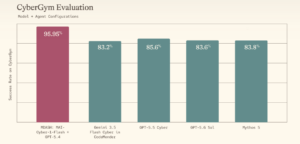
Microsoft highlights that the combined MDASH system achieved a 95.95% score on the CyberGym benchmark. The stats outperform several competing AI systems in software vulnerability identification and exploit generation.
MAI-Cyber-1-Flash inside MDASH contains a sparse mixture-of-experts architecture with 137 billion total parameters but activates only around 5 billion parameters during inference. The design allows the model to deliver faster responses while maintaining high performance for cybersecurity workloads.
Microsoft’s Advanced Cyber Defense Strategy
Microsoft introduced an agentic cybersecurity platform, Project Perception, alongside MAI-Cyber-1-Flash. The platform extends MDASH with collaborative AI agents capable of performing continuous vulnerability scanning, patch analysis, and remediation planning. Project Perception coordinates multiple AI agents that specialize in different security tasks, rather than functioning as a standalone chatbot.
Microsoft believes this agent-based approach better reflects how enterprise security teams operate. It will allow AI systems to automate repetitive work while keeping human analysts involved in critical decisions.
Microsoft’s Efforts to Address AI-Driven Threats
Cybercriminals increasingly use artificial intelligence to automate phishing campaigns, discover vulnerabilities, and develop malware. Additionally, professionals find that traditional cybersecurity tools struggle to match the speed at which modern attacks evolve. So, Microsoft’s step to launch MAI-Cyber-1-Flash and Project Perception reflects stronger strategies to address these challenges.
Microsoft noted during the announcement that cybersecurity now requires AI systems capable of reasoning, adapting, and operating continuously. Under such circumstances, specialized models are becoming essential because attackers can cause exploits at machine speed. This ultimately doubles the pressure on defenders to respond equally quickly.
Availability of MAI-Cyber-1-Flash and Project Perception
Microsoft plans to make MAI-Cyber-1-Flash and Project Perception available through a public preview beginning next month for selected customers and security researchers. The company asserts it will continue expanding MDASH with additional specialized AI models and security agents as organizations seek more effective defenses against rapidly evolving cyber threats.
SecureITWorld is a leading hub for tech news, insights, and expert-driven takeaways. Explore breakthrough innovations with us.
Also Read:
Cybersecurity for E-commerce: Protecting Your Online Store
Managed Security Services (MSS) vs. In-House Cybersecurity: Which Model Suits Your Business